| |
| Tuesday, 08 September 2026 |
| Battersea Power Station |
| Ian Swankie |
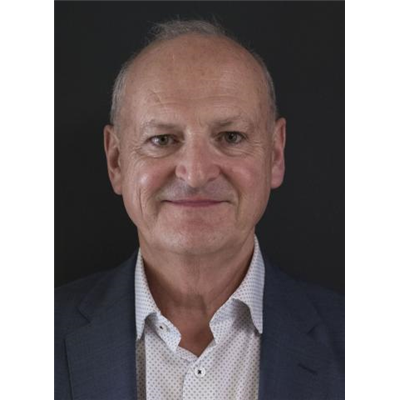 |
Ian Swankie is a Londoner with a contagious enthusiasm for art and architecture. He is an official guide at Tate Modern, Tate Britain, Guildhall Art Gallery and St Paul’s Cathedral and is also a freelance London tour guide. Since 2012 he has led a popular weekly independent art lecture group in his home town of Richmond in West London. As well as being an Accredited Lecturer of The Arts Society, he is also a Freeman of the Worshipful Company of Art Scholars, one of the City livery companies. This is a talk about just one building. It has 60 million bricks, four chimneys and an amazing story to tell. Planned in the 1920s, the massive power station operated for fifty years but was then abandoned for the next forty years while dozens of ideas were proposed for its use. It is now a Grade 2* listed building and has been brilliantly converted into a landmark development including residential, retail, offices and leisure which all still reflect its industrial heritage. Note: This event will commence at 10:40 with a short Annual General Meeting. The lecture will start at 11:00. |
|
| Tuesday, 09 June 2026 |
| No Husband Needed, I Fly a Spitfire |
| Melody Foreman |
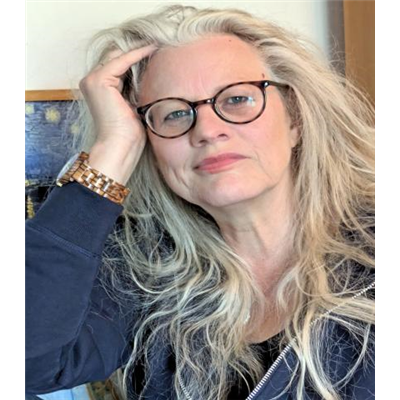 |
Melody Foreman is an author, journalist, cultural historian and biographer. She is a graduate of the University of Kent, and the University of Utrecht in The Netherlands. She has worked as a researcher on ITV documentaries, was the editor of an award winning newspaper and is the author of four non-fiction titles. This was an absorbing lecture about Mary Wilkins Ellis who, as a civilian during WWII, nevertheless worked as a pilot for the Royal Airforce. During the years of the Second World War a short lived, but remarkable, organisation was formed and Mary and her colleagues were eventually and rather begrudgingly invited to join. The Air Transport Auxiliary (ATA) was a civilian service that was tasked with the delivery of aircraft from factories to the squadrons of the RAF and Royal Navy and the delivery of supplies. The ATA pilots wore a uniform designed by the RAF so they could be instantly recognisable when arriving at delivery sites. Mind you, when all 5ft 2in of Mary single-handedly, delivered a Vickers Wellington bomber, the baffled ground crew refused to believe she was the pilot and searched the aircraft for the "real" or "missing" pilot. Melody, as the author of ‘A Spitfire Girl’ had developed a special relationship with this remarkable woman and her knowledge was based on Mary’s recollections. Melody related the fascinating story of how the women of the ATA group, nicknamed ‘the Attagirls’, came to be formed. These women already possessed pilot’s licenses as they had grown up being fascinated by flight. This meant that piloting was in their blood and they fully understood the physics of flight and the purpose of the plane’s controls. Therefore, with this understanding, once the instruments of a new aeroplane were explained to them, they could fly it. Moreover they understood the vagaries of the weather and could fly in most conditions. For your interest, an alternative interpretation of ATA, was ‘Ancient and Tattered Airmen’ as the pilots recruited were considered unsuitable for either the Royal Air Force or the Fleet Air Arm by reason of age, fitness or sex! Physical disabilities were ignored if the pilot could do the job. Thus, there were one-armed, one-legged, short-sighted and one-eyed pilots. Surely the gentleman officers of the RAF did not consider the Attagirls to fall into this category? To view a few of the images presented, please click HERE |
|
| Tuesday, 12 May 2026 |
| Paris 1925 - Birth of Art Deco and Modernism |
| Anne Anderson |
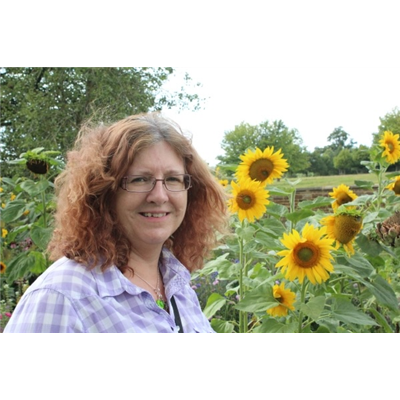 |
Prof. Anne Anderson FSA was a senior lecturer at Southampton Solent University for fourteen years. She went on to curate four national exhibitions, most recently Beyond the Brotherhood: the Pre-Raphaelite Legacy (2020). Her most recent book, published in 2020, is Art Nouveau Architecture (Crowood). Anne has also published over a hundred academic papers in internationally recognised journals. Many great performances have a good warm-up act preceding them. Our esteemed chairman Ray was taken unaware by the Professor leaping to her feet and elaborating on the places TASEG had planned to visit. But, it worked and became an entertaining and humorous pre-lecture presentation. This gave us an inkling of what was to come. We were suddenly transported to 1925 Paris and their famous exhibition. We had just returned from our TASEG holiday to Paris and were able to appreciate where this extensive event was held. The slides were numerous, the architecture of the pavilions was wide ranging from the numerous French buildings greatly influenced by Lalique to a very austere Russian pavilion. The exhibits ranged from extremely modern and somewhat uncomfortable furniture to home furniture rather over-upholstered and rather dull. Examples of pottery ranged from the implausible and impractical to the beautiful and colourful vases which sell now for impossible prices. The art works and statues ranged from impossibly slim and graceful depictions of women to the use of wave shapes which also appeared in the architecture of the pavilions but also survives in grand buildings today. Wow, Anne is a lecturer with boundless energy, an amazing knowledge of her subject and a lovely sense of humour. We were all stunned when the end of the lecture was reached and we took time to recover enough to ask Anne questions which of course were flawlessly answered. Another lecture by this maestro please. For a selection of images presented during this lecture, please click HERE |
|
| Tuesday, 14 April 2026 |
| A Meeting with Virginia Woolf |
| Karin Fernald |
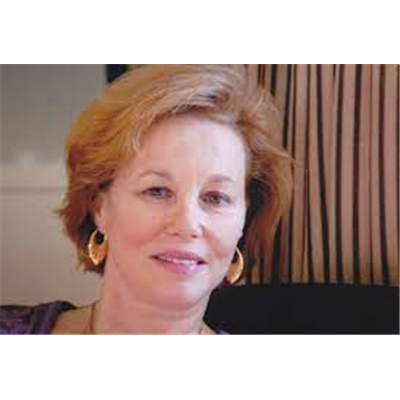 |
Karin Fernald is an actor, writer and entertaining speaker who researches and creates a vivid picture of a historical character and period. An established speaker for the Arts Society, Karin is known for lectures on charismatic wits, diarists and writers from the 18th and 19th centuries. All her subjects are connected with the fine arts; some - Queen Victoria, Hans Christian Andersen - are artists themselves. This was a highly original lecture given by an Actress who was born in Rothesay, Isle of Bute, Scotland in 1942. Karin had appeared in many well known television productions including ‘The Scarlet and the Black’ (1965), ‘Watch the Birdies’ (1966) and in the landmark 1967 BBC production of ‘The Forsyte Saga’, where she played the role of Ann Forsyte (née Wilmot). We soon realised that Karin had been an actress as her voice betrayed her past. Her lecture was melodic and fluent particularly when reading extracts from Virginia Woolf’s books. Virginia had a very complicated personality much of which had stemmed from a rather disturbed and unhappy childhood. Her close friend Vita Sackville-West described her authorship as by far the best of the close-knit Bloomsbury Group of which both were members. This group of unconventional artists and writers met originally in Bloomsbury Square in London but later lived in Charleston House in Firle in Sussex with the Woolfs lived nearby in Monks House in the village of Rodmell. Their lifestyle reflected their rejection of Victorian conventions and promoted liberal, artistic and personal lives. Karin’s lecture took a rather more light-hearted approach to Virginia Woolf and her writings, excerpts of which were movingly read to us. We gained some insight into Virginia’s personality especially from her book ‘Am I a Snob?’ and her short story ‘The Mark on the Wall’. Our previous TASEG outing to Charleston had given us a background to an extraordinary group of people who had mutually influenced each others works of Art and Literature. May I recommend ‘Among the Bohemians’ by Virginia Nicholson granddaughter of Vanessa Bell (an artist and original resident of Charleston). This helped me better understand the nature of the Bloomsbury Group. To view a few of the images discussed, please click HERE |
|
| Tuesday, 10 March 2026 |
| Ways to Look at Painting |
| Alice White |
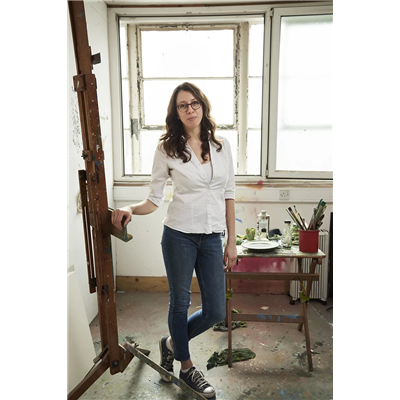 |
Alice White is a contemporary oil-painter, and a Tutor at the University of the Arts London and University College London. She has provided Guest Lectures at King's College London, The Art Workers' Guild, the Courtauld Institute of Art. This was a highly energetic, informative and enjoyable lecture. An unusual mixture of Art and Science, it was beautifully illustrated with paintings of different genres and ages. The use of zoom techniques allowed one to fully appreciate the effects of different painting techniques and paint mixtures. For example, the amazing self portrait of Rembrandt, which I have always admired for its use of light and astonishingly realistic facial skin, was achieved by mixing egg yolk with oil paint, known as impasto, so light was reflected as a soft sheen. Alice was so enthusiastic about her subject that she carried us all with her and the one hour duration was far too short. We examined art work by Rembrandt, Turner, Pollock and Fontana. We were transported from Rembrandt’s incredible portrait painting, through Turner’s revolutionary depiction of light and Impressionism to the modern and experimental methods of Pollock and Fontana. We looked at the different techniques of the artists from painting indoors on easels and canvasses to painting outdoors with the challenges involved with equipment, weather and importantly changes of light. To placing huge canvases and boards on the floor and literally and randomly throwing paint from the perimeter. Suddenly, it was not just an artist standing reflectively applying paint but physical exercise and almost contortionism was involved in the creation of an Art Work. When questioned about the latter and my lack of appreciation of the end result, Alice explained that yes anyone could have tried the technique involved but in fact nobody had. The development of Art was due to artists brave enough to try different techniques, invent different and unusual paint components and different methods of application and materials used. I learnt so much and will certainly look at paintings a lot more closely than I have before. This is the mark of a great lecture - thank you Alice. PS I still don’t like some modern Art but I do appreciate what produced it! For a selection of images presented, please click HERE |
|
| Tuesday, 10 February 2026 |
| Not All Bagpipes are Scottish |
| Sophie Matthews |
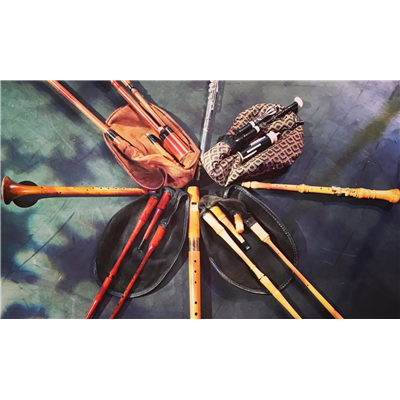 |
Sophie Matthews is a musician well-known for her prowess on the English border bagpipes and has become one of the foremost players of the instrument in the UK. She also plays a variety of early woodwind instruments such as shawm, rauschpfeife, crumhorn and recorder. Sophie is one of a handful of British players of the baroque musette, an 18th century French bagpipe similar to the Northumbrian smallpipes. When not touring with GreenMatthews, Sophie also makes instruments (she made her own baroque oboe) and works with respected luthier Tony Millyard on his flutes. She is self-taught on all of her instruments. I (and I suspect many in her audience) approached this lecture with a mixture of curiosity and trepidation. Sophie began her lecture with the podium draped with strange inanimate objects. I needn’t have worried. Sophie proved to be energetic, informative, interesting, fluent and very musical. Her lecture lived up to its title. We soon found out that bagpipes existed long before they reached Scotland. With a mixture of very illustrative slides, we soon learnt how rudimentary the early bagpipes were. Shepherds were early constructors and players of bagpipes. Not really surprising because they were cheap to make from animal hides and wood. We were treated to a fascinating lesson on how the construction of the instrument developed as it gained more prominence and was accepted by the aristocracy. How bagpipes differed from directly filling the bag by blowing in air and pumping with the arm applying different pressures or by using bellows strapped to a waist band. How different octaves were achieved by adding drones. How notes were played by the fingers closing holes in an open ended chanter or by lifting fingers off holes in a closed end chanter. How the materials used varied from rudimentary to extremely expensive. Then, suddenly the instruments around her came to life and magically played by Sophie, produced music of great variety from rustic to classical music. It was wonderful and my toes soon started tapping and my imagination wandered from village greens to concert hall. What a wonderful self taught musician she is! Her audience was carried along by her enthusiasm. We had so many questions for her at the end, she had to be rescued in order to have some much needed lunch. I commented to a very musical friend afterwards that I could imagine how terrified enemies of the Scots would have been when confronted by a regiment in full highland dress playing deliberately discordant bagpipes! What a treat! For a selection of images presented, please click HERE |
|
| Tuesday, 27 January 2026 |
| Alla Moda: - Mid-Century Modern Italian Ceramics |
| Mark Hill |
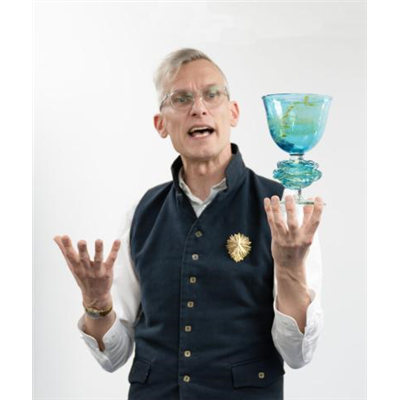 |
Mark Hill studied History of Art & Architecture (BA Hons), and began his career as a porter and Junior Cataloguer at Bonhams, before moving to Sotheby's where he was a Specialist in the Collectors' Department. He founded his own publishing company in 2005 and has published over 15 books on emerging specialist subjects in the decorative arts. Mark has been a miscellaneous expert on the BBC 'Antiques Roadshow' since 2007, an expert on the BBC's 'Antiques Roadtrip and is a member of the British Antiques Dealers' Association (BADA.org). Mark is well known to TASEG members as he has already delivered three fascinating ceramic lectures for our Special Interest Day (SID). Also, he regularly features in the Antiques Road Show wearing some exotic outfits. We knew he would deliver a really good lecture. Oh boy, was that the case! Our esteemed Chairman Ray summed it up with one word ‘BRILLIANT’! Mark has an imposing presence on stage. He is erudite, witty and highly energetic. He swept me (and I suspect most of his audience) along with him. When he said this is my final slide, the past hour had flown by without me realising it! His slides were beautifully constructed and informative. He talked about the ceramics depicted, their relevance to the fashionable art of the time and the potter. We learnt the importance of the mark on the base of the ceramic where provenance very much impacted the value. We gained an insight into how the more unusual and complicated pieces were made. We gained some knowledge of slip-moulding versus hand shaping using the potter’s wheel. How the type of glazing affected the look of a ceramic and how to distinguish between hand-painted art and mass production. Mark does not just research the historic work of others. He travels to where and by whom the ceramics were created. If he finds very unusual ceramics, he fully investigates their origin and the history of the pottery involved. Judging by the quality of the questions after the lecture, there is no doubt that he had fully engaged his audience who were only too keen to find out more. On my return home, I found myself turning my ceramics upside down and certainly regarding them in a very different light. One more comment I will make is that I love the Art, History, Culture and Climate of Italy and can readily understand how such colourful ceramics evolved. For a selection of the images presented, please click HERE |
|
| Tuesday, 25 November 2025 |
| The 12 Plants of Christmas |
| Timothy Walker |
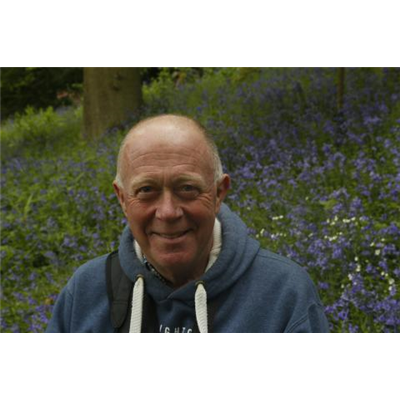 |
Timothy Walker read Botany at University College Oxford. After graduation, he worked as a trainee at Oxford Botanic Garden, the Savill Garden Windsor, and the Royal Botanic Gardens Kew and in 1985 was awarded a Master of Horticulture by the Royal Horticultural Society of London. From 1988 to 2014 he was director (Horti Praefectus) at the Oxford Botanic Garden which, between 1992 & 2000, won 4 gold medals at the Chelsea Flower Show London. In 2010 Timothy was elected as a Fellow of the Linnaean Society of London. Since 2014 he has been a tutor in Plant Biology at Somerville College, Oxford. What were we expecting? Timothy looked reserved and studious before he started his lecture. What a surprise was in store! We were soon to realise that this lecture was going to be a real pre-Christmas treat. Timothy is a remarkable lecturer. His knowledge of Botany was all-encompassing so no need for lecture notes. His only prompts were his delightful, educational and well designed slides. His delivery was fluent, relaxed, enjoyable and sprinkled with highly amusing asides. I couldn’t stop chuckling but soon realised that I was not alone as laughter rippled through his audience, sprinkled with murmurs of appreciation. What a brilliant way to introduce us to the nomenclature, structure and history of plants! His theme of introducing us to plants associated with Christmas was extremely interesting. He took the theme of the carol ‘The Twelve Days of Christmas’ and completely dismantled the well-known lyrics. His main argument was that we are surrounded by plants at Christmas, many traditional and much loved, but only one plant is in this popular Christmas song and that is the pear tree which incidentally does not fruit at Christmas! For example ‘Maids-a-milking’ was replaced by mistletoe and Poinsettias replaced ‘The Partridge’. Not surprisingly, Timothy also pointed out that Partridges are in fact ground-dwelling birds! He even managed to include marzipan by referencing the almond tree. The spontaneous applause when Timothy concluded his lecture demonstrated how enjoyable it had been. There was something for everyone whatever their botanical knowledge. I am sure that his students at Pembroke and Somerville Colleges, Oxford flourish with him as their tutor. This got me thinking. As you put up the decorations this Christmas, enjoy the plants which adorn your houses and remember that even the cards and wrapping paper are made from trees, which as Timothy rightly said are in fact plants. Happy Christmas to you all! |
|
| Tuesday, 11 November 2025 |
| Chopin: An Intimate Portrait in Words And Music With Marguerite Duncan-Sutherland (Narrator) AND Stephen Baron (Piano) |
| Stephen Baron |
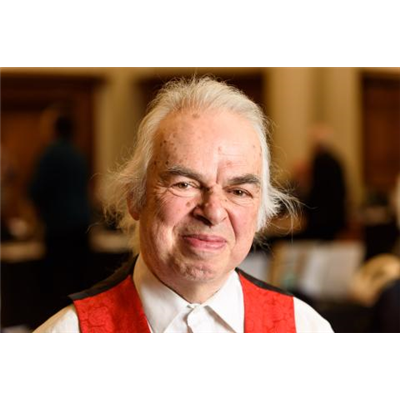 |
Stephen Baron is a well-known pianist, accompanist and composer and is also an experienced lecturer in music, having worked for seventeen years at Birkbeck College and several other London institutions. He has recently released a Chopin CD and also a CD of songs with Marguerite Duncan-Sutherland with whom he presented this lecture. Frédéric Chopin was born on 1st March 1810 in Zelazowa Wola, Poland. He died on 17th October 1849 in Paris, France at the tender age of 39 years. Chopin discovered music very early as his father’s employment exposed his young son to cultured Warsaw society. This child prodigy was already ably playing the piano and composing music at the age of 6 and 2 years later, in 1818, was performing in elegant salons and composing piano music including his famous Polonaise in G minor. Child prodigies are fascinating as their prowess, in usually either music or mathematics, shows an ability not only amazing for their age but also rarely matched by others. This is not to say that Chopin achieved without help and outside influence as he attended the Warsaw Conservatory of Music, where he studied for three years under Polish composer Josef Elsner. His parents supported him throughout and to broaden his musical education, sent him to Paris. There he became acquainted with similarly aged composers such as Liszt, Bellini and Mendelssohn. He also performed to great audience admiration. His combination of romantic music and amazing technical ability was much appreciated. His awkward personality, often associated with high achievers, meant that he had difficulty forming close friendships but he did however fall in love with George Sand, the French novelist Amantine Lucile Aurore Dupin, with whom he had an affair. She cared for him when he became ill with consumption (tuberculosis) from which he later died. The lecture was illustrated by portraiture of Chopin and his musical associates and, of course, George Sand. Marguerite’s narration covered the most significant moments of Chopin’s life whilst Stephen’s piano playing amply demonstrated the development of Chopin’s style especially when under the influence of other composers’ works. This was a multi-layered approach and his audience was able to appreciate Chopin’s music according to their own background in musical training and performance ability. This proved to be unusual presentation which demanded a great deal of co-ordination between Narrator/Slide presenter, Pianist/Technical Musical Lecturer and the Chequer Meads technician. For a selection of images presented, please click HERE |
|
| Tuesday, 14 October 2025 |
| Christopher Marlowe: Poet and Spy |
| Giles Ramsay |
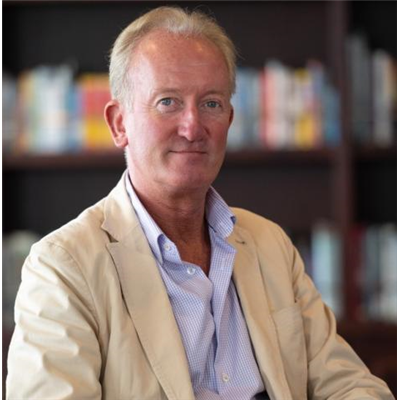 |
Giles Ramsay is an independent theatre director and producer who specializes in creating new work with artists in developing countries. He is the Founding Director of the charity Developing Artists (www.developingartists.org), a former Fellow of St. Chad’s College, Durham University and Course Leader in Theatre at The Victoria and Albert Museum in London. Giles spoke fluently for nearly 60 minutes without “hesitation deviation or repetition”. He started with reference to the grammar school boy of Stratford who was born in the same year as Marlowe. Giles set the scene with an excellent resume of the state of affairs in England including the insecurity of the Tudor monarchs’ claim to the throne and the religious strife in Europe. It was a time when men were prepared to murder and be martyred for their religious faith. The Elizabethan security services were zealously gathering intelligence against a militant enemy but also a Golden Age Theatre emerged in England. Giles explored both these threads discussing Marlowe’s plays and poetry making reference to Tamburlaine, the Jew of Malta and Dr Faustus all of which were known to us and the fact that Marlowe was the first to achieve critical reputation for his use of blank verse. Less known to me is the idea that it is also quite possible that Marlowe was a government spy, possibly recruited when he was at Cambridge. When the Privy Council ordered the University of Cambridge to award Marlowe his degree as Master of Arts, it denied rumours that he intended to go to the English Catholic college in Rheims, saying instead that he had been engaged in unspecified matters touching the benefit of his country. So was his early death the result of a drunken brawl or was he assassinated? Academics cannot agree. Certainly he was an admired and influential artist. Giles finished his lecture as he began with a reference to Shakespeare suggesting that Marlowe with his superior education at Kings School Canterbury and then at Corpus Christi in Cambridge, by his death cleared the field for the success of the grammar schoolboy from Stratford. Assassinated at the age of 29, Christopher Marlowe was very much a man of his times. |
|
| Tuesday, 09 September 2025 |
| van Gogh's 444 days in Provence |
| Mariska Beekenkamp-Wladimiroff |
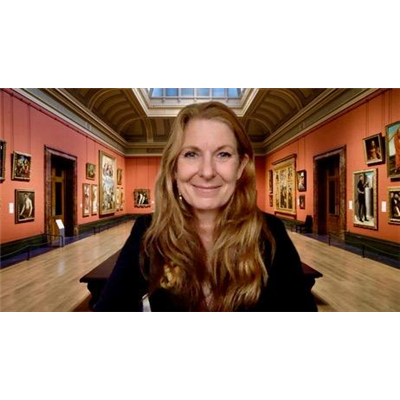 |
Mariska Beekenkamp-Wladimiroff read Social Psychology at the University of Amsterdam and was tempted to do a PhD in Decision Making Behaviour. In the end she turned to her true love - the Arts. This was a fascinating lecture delivered by a Dutchwoman about a Dutchman. To begin with we learnt the correct gutteral pronunciation of Gogh that I could never master despite having lived in The Netherlands for a while. I was totally biased even before Mariska started talking as I love Impressionistic Art, particularly Van Gogh and his use of the light and strong Provençal colours. I also have a high regard of the Dutch with their straight talking and warmth. Mariska gave us an insight into Vincent’s character and personality, his difficulty in keeping friends and his lack of direction and staying power. His artistic ability did not show for years as, although he developed a love and appreciation of Art, he never really fitted into Artistic circles, Galleries or Art Courses. His only real friend was his younger brother, Theo, who advised him to become an Artist and supported him both emotionally and financially. Van Gogh’s relationship with his parents was somewhat fraught as they had difficulty understanding or recognising his mental health problems. They worried about his inability to financially support himself, his difficulty with relationships and his apparent lack of stickability at any work or project. However Art was intrinsic to Vincent and when he lived in Provence he thrived. Paul Gauguin briefly lived with him in ‘The Yellow House’ in Arles. Vincent developed his very individual impressionistic style. His use of bold wavy brush strokes, his love of painting rural folk and scenes and his amazing landscapes and vibrant flowers are instantly recognisable. His skill in portraiture and capturing the personality of his subject was amazing and his self-portraits portray his deteriorating mental health. Sadly Vincent van Gogh’s art was never really appreciated until after his untimely self-inflicted death. Nowadays he is truly appreciated as one of the world’s greatest Artists. If you are further interested, I suggest you visit the van Gogh Museum website HERE For some of the images discussed in the lecture, please click HERE |
|
| Tuesday, 10 June 2025 |
| Ancient Egypt at the British Museum |
| Vicky Bailey |
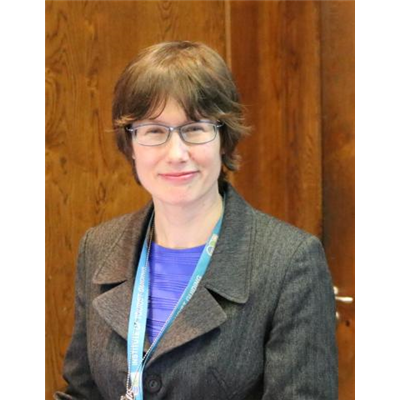 |
Vicky Bailey became a London Blue Badge Tourist Guide in 2005, receiving an award as the 'Best Guide in Gallery Exams', one of her main areas of interest being Ancient Egypt. She has studied hieroglyphs and carries out volunteer work in the Egyptian department at the British Museum. Vicky leads specialist tours at relevant sites across London and also delivers lectures on this subject. When I think of ancient Egypt my mind immediately conjures up images of pyramids, tombs, mummified bodies, and of course the pharaohs. I was keen to learn more about its legacy as we were transported to the British Museum’s Department of Ancient Egypt. It is home to myriad pieces and artefacts which give insight into this sophisticated and complex civilisation. Vicky’s knowledge of her subject is noteworthy. She engages the audience through her fluent delivery, enhanced by clear visual references. Where to start on a civilisation which lasted over three thousand years, its written history locked in hidden vaults and tombs. Excavated objects displayed hieroglyphs which for centuries no-one knew how to read. That changed at the end of the 18th century during Napoleon's military campaign in Egypt. While digging fortifications near the port of Rosetta, French soldiers unearthed a massive slab, revealing the Rosetta Stone. This led to the deciphering of the ancient Egyptian language and hieroglyphic script by the linguistic scholar Jean-François Champollion and Thomas Young, physicist and genius. There are 3 scripts on the Rosetta Stone - hieroglyphic, demotic and ancient Greek. The hieroglyphs with symbols including animals we recognise today, provide a detailed history of the ancient Egyptians. You can’t cover three thousand years in one hour. Vicky’s choice of subjects and illustrations gave us a comprehensive insight into their society - the religious beliefs, hierarchy, politics, art, architecture - through the Old Kingdom, the Middle Kingdom and the New Kingdom. Cleopatra VII the last queen of the Ptolemaic dynasty died in 30 BC. Everyone has heard of mummies, but I didn’t know that during the process the vital organs were removed to be preserved separately. Interesting that such an intelligent, advanced race, didn’t think the brain was important and so it was discarded! Brains which designed the pyramids, understood astronomical patterns, engineering, created a complex language system…… Preparation for the after-life was essential. Pharaohs and prominent citizens believed their existence would continue after death. Tombs were filled with priceless treasures to ensure safe passage. Not really surprising that so many were robbed. The lecture covered so much ground - false doors, shabtis, tomb paintings, famous pharaohs, gods, goddesses, myths, beliefs and more. Talking to other members afterwards, some of whom had already visited Egypt, the general feeling was that this was a well presented talk. I certainly will add a visit to Egypt to my bucket list, but in the meantime a return visit to the British Museum is long overdue. |
|
| Tuesday, 13 May 2025 |
| The Unknown Churchill - Winston Churchill and Blenheim Palace |
| Antonia Keaney |
 |
Antonia Keaney joined Blenheim Palace in 2008 as a member of the Education Team, later becoming the Palace’s Social Historian and Researcher. Both roles have involved her curating or co-curating a number of Palace exhibitions including A Passion for Fashion – 300 Years of Blenheim Style upon which her recent book is based. Antonia’s latest project has been to produce a series of podcasts - Behind the Scenes at Blenheim Palace. I thought I knew a lot about Winston Churchill. As with most British people who had been through WWII, he was revered by my family and often talked about. When a London University student, I stood with my future husband joining thousands lining Fleet Street on a freezing January day (30/01/1965). In fact, my husband and a friend had paid their respects at his lying-in-state in Westminster Hall. We have also visited Blenheim Palace and Chartwell and read books on Churchill, particularly that written by his Doctor. What was so refreshing about Antonia’s lecture was her deep knowledge of Churchill’s antecedents, as well as the man himself. This was based on her extensive research as Blenheim Palace’s Social Historian and Researcher. She has been employed by the Palace since 2008 and is still in post. Not only is she surrounded by portraits of the Churchill/Blenheim dynasty but her work allowed her to research private papers and letters in their archives. We were given a wonderful insight into the family history from John Churchill, the 1st Duke of Marlborough, who was gifted his land by Queen Anne together with money sufficient to build his astonishing Blenheim Palace at Woodstock. This in gratitude for his leading the allied forces to defeat Louis XIV and the French at Blenheim (1704), Ramillies (1706) and Oudenarde (1708). This amazing generosity was no doubt helped by his wife, Sarah Jennings, who was an Attendant to the Princess, later Queen, Anne. Who you know is as important as what you know! We were given a family history down through the generations to Winston himself which included portraits, photographs, letters and details such as Winston’s complete disregard of academia! Very much his own man who battled depression (his ‘black dog’), Winston became a great statesman whose wisdom, strategic thinking and bravery to stick to his decisions, saved our country from invasion and from the Nazi’s. Oh, and the little matter of a Nobel Prize for Literature, some lovely paintings and the support of his wife, Clementine all contributed to his renown. Antonia delivered this very memorable lecture in a relaxed and humorous manner which fully engaged her audience. The end came far too soon and left one hungry to further explore that incredible family. For a selection of images, please click HERE |
|
| Tuesday, 08 April 2025 |
| The Odd Couple: The Gardens of Edwin Lutyens and Gertrude Jekyll |
| Stephen Desmond |
 |
‘The Odd Couple’ was certainly an aptly named lecture. Gertrude Jekyll (1843 - 1932) was both physically and culturally an unlikely candidate to become known as one of England’s most renowned horticulturalists of her time and her style still influences modern garden design. Edwin Lutyens (1869 - 1944) was 26 years younger than Gertrude but nevertheless between them they created gardens which retain their appeal and popularity to this present day. Edwin came from a comfortable background and was encouraged by his father to study Art at the Royal School of Art. Gertrude, also from a well-off family, was actively discouraged by her parents from pursuing her love of Art and gardening. They would have preferred her to adopt the more feminine pursuits of the day such as embroidery, piano playing and attracting a suitable husband. She neither married nor had children and preserved to enrol at the Kensington School of Art. The Odd Couple’s partnership became hugely influential in the Arts and Crafts movement where Edwin’s architectural creativity blended well with Gertrude’s outstanding design use of radiant colours and Turner-style plantings. Stephen Desmond’s style of lecturing both engaged and amused his audience. One felt a respect for his subjects and their achievements. His dry wit and use of slides demonstrated his subjects’ personalities and relationship, in particular Edwin’s cartoon depicting himself prostrated before a very imposing (and rather large!) Gertrude. Edwin was highly valued for his architecture and was knighted as a result. He designed many prominent buildings in India and in England, the best known being The Cenotaph in Whitehall. Gertrude’s planting designs perpetuate to this day. What struck me most was that she was a woman ahead of her time. She created her own business, worked with Edwin as an equal partner and was highly esteemed by her peers. For a selection of images presented, please click HERE |
|
| Tuesday, 11 March 2025 |
| Urban Noir: Edward Hopper's "Nighthawks" |
| Kathy McLauchlan |
 |
A lecturer specialising in 19th-century art history, Kathy McLauchlan is currently a course director at the Victoria & Albert Museum, organising courses and study days on the history of art and design. She teaches at several institutions, including Art Pursuits, and is a graduate of Oxford University and the Courtauld Institute, with a PhD on French 19th-century painters in Rome. What I love about the Arts Society is attending a monthly lecture where I have absolutely no knowledge of the subject matter. Nighthawks in my interpretation were probably nocturnal raptors and Edward Hopper was unknown to me. So I approached this lecture completely open-minded. Our lecturer certainly knew her subject matter. She spoke with authority and enthusiasm and her style compelled one to completely concentrate on her topic. Edward Hopper (1882 - 1967) was an American realist painter and printmaker. He is one of America's most renowned artists and known for his skill in capturing American life and landscapes through his art. Born in Nyack, New York, to a middle-class family, Hopper's early exposure to art was nurtured by his parents. I was fascinated by Kathy’s approach to Hopper’s paintings. His realistic style was uncluttered, simplistic in his colour palette and almost photographic. However, we were drawn into his paintings and were given an understanding of what he was depicting. The loneliness of humanity in a large, overwhelming city made one think of one’s own experiences in London. Sitting in a tube carriage with many people all unknown and refusing to make eye-contact, lost in their own worlds or nowadays buried in their mobile phones. Walking along Fifth Avenue in New York and looking at St Patrick’s Cathedral black with grime, dwarfed by skyscrapers which masked the sunshine and dulled the street. Approaching a city by rail with the associated anonymity of a big railway station. Suddenly one was there, inside the painting, empathising with the people depicted and comprehending their isolation and loneliness. I have not before fully understood what was an artist’s intention when painting a scene. Well done Kathy for what was a very enlightening, educational and enjoyable lecture. For a selection of the images presented, please click HERE |
|
| Tuesday, 11 February 2025 |
| Gilding the Stage: A Brief History of the Modern Opera House |
| Raymond Holden |
 |
Born in Australia, Professor Raymond Holden AM studied at Sydney, Cologne and London and is both a critically acclaimed and a multi-award winning writer, conductor, broadcaster and lecturer. Unusually, the stage at Chequer Mead was set with a lectern and chair on its apron to the right balancing the pedestal with its flower display on the left hand side. Was this ‘Gilding the Stage’? ‘A Brief History of the Modern Opera House’ had sounded rather dry and several of our members, including my husband, had been somewhat apprehensive about its content. Professor Raymond Holden, born in 1954, looked conservatively dressed and very academic. Wow, were we in for a surprise! His lecture style was dynamic, entertaining, humorous, stimulating, informative, well-illustrated and well-informed. His passion for opera was very obvious and this enthusiasm was easily transmitted to his audience. His walking stick and need to sit was obvious but his energetic movement and lecturing style told a different story. No need for a microphone, this was a man well used to recounting a story and projecting it to an audience who were soon entranced. We learnt about the history of the Opera, where Opera had been performed over time and over the world, performers, music, costumes, stage settings and types of audience. All this was accompanied by illustrative slides, music and videos. Examples ranged from the sublime to the ridiculous! We were allowed to laugh at the extravaganza of costume, behaviour and presentation. We had a very amusing and forthright explanation for the Castrati and Coloratura. The former being highly paid for their high and pure singing voice whilst remaining adult in appearance. The latter sometimes embellishing their own performance contrary to the composer’s wishes. We saw how stage settings developed with the predominant Art of the time including Impressionism and Cubism. How costume developed from historic to modern dress. How the audience varied over the ages from country to country, from populism to exclusivity particularly in the UK! How operatic orchestras gained a higher profile and moved from the stage to the orchestra pit. How the language of opera changed according to where it was performed and the eventual use of surtitles. What a treat! |
|
| Tuesday, 28 January 2025 |
| Caspar David Friedrich and Early German Romanticism |
| Colin Pink |
 |
Colin Pink has a BA in Philosophy and Politics from the University of Southampton and a MA in the History of Art from Birkbeck, University of London, and specialises in twentieth century and contemporary art in Europe and North America. He lectures at Morley College London. He has also curated exhibitions of contemporary art and has published four books of poetry. The main theme of his lecture was the link between the philosophy of Immanuel Kant (born Emmanuel Kant; 1724 - 1804) and the art of Caspar David Friedrich (1774 - 1840). Kant was an eminent German Philosopher and one of the central enlightenment thinkers. His prominence remains as the father of modern philosophy. Put in simple terms, prior to Kant and his contemporaries’ thinking, moral beliefs and practices were grounded in religion. The rules by which people lived came from a divine source of wisdom. The scientific revolution of the 16th and 17th centuries led to a great cultural movement known as the enlightenment. The conclusion of many of its adherents was that human reason was the dominant force. Friedrich adopted this philosophy in his paintings which depicted the enormity of the Universe compared to the insignificance of man. He developed an Art form focused on a more natural landscape in which tiny human figures were dwarfed by the magnificence of nature. Formerly landscape painting had rather artificially acted as a backdrop to portraiture. The slides chosen to illustrate Friedrich’s paintings were therefore concentrating on this aspect of Kant’s philosophy. There were occasional glimpses of Friedrich’s other paintings which were more colourful than some of the rather misty, wistful art that was mainly depicted. J W Turner was a contemporary of Friedrich’s and it looks highly likely that they may have influenced each other in their style of painting. It is a shame that Turner became much appreciated worldwide whilst Friedrich was almost forgotten except for his native Germany. For a selection of the paintings discussed, please click HERE |
|
| Tuesday, 26 November 2024 |
| "Harp and Holly" - Its History, Design and Music with a Seasonal Flavour |
| Margaret Watson |
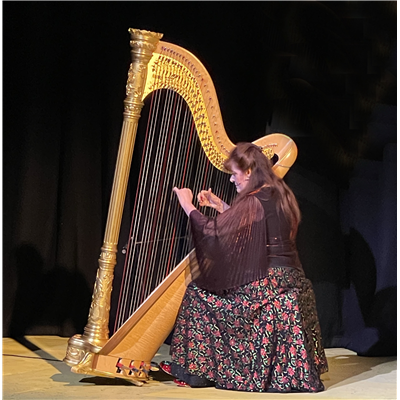 |
What a pre-Christmas treat we had! The stage was set. Harp on the left, podium on the right and projection screen between. Where was the holly? It soon came. It adorned every slide and Margaret Watson herself. A vision in sparkling festive red and green, trotting backwards and forwards between harp and podium as she embellished her slides with beautiful harp music . We learnt about the evolution of the construction of the harp over thousands of years. Her lecture was accompanied by many varied and extremely interesting slides. We found about the use of the harp in royal courts and throughout society. Beautiful paintings demonstrated all including their use in religious portraits with angels strumming impossibly heavy harps whilst maintaining their appropriate position in the heavens. We found out the difference between harpists and harpers. The former played harps with a pillar and complicated mechanism so flats and sharps ( the black notes on the piano keyboard ) could be played and the harpers played Irish harps that could be carried around and could only play the equivalent white notes of a piano. Furthermore, a harpist plays the strings using the pads of each finger meaning that the pads develop callouses. A harper, on the other hand, plucks the strings with the finger nails. Margaret demonstrated the use of the pedals on her harp including demonstration videos as her feet rapidly moved from pedal to pedal. For example an f sharp required a pedal which activated a linked mechanism running through the vertical post of her harp and sharpened every f string. Unusually black notes both above and below a white note could be played on the harp simultaneously. This allowed for the beautiful glissando in a performance. I glanced around the audience and realised that every TASEG member was transfixed by Margaret’s performance. Their applause at the finish was generous and enthusiastic. Questioning Margaret both then and afterwards at our festive nibbles revealed the following. Her love of the harp began very early when as a child she heard it in a musical introduction to a children’s programme. She begged her parents for harp lessons and they found a harp teacher in Reigate. She proved a natural and was awarded a place at the Guildhall. All Margaret had ever wanted was to perform, not to teach or join an orchestra. What a fantastic performer she is and not only us but many across the U.K. from Royalty to hospice patients have benefitted greatly from her talent and exuberance. For pictures that illustrate the key change mechanism, please click HERE |
|
| Tuesday, 05 November 2024 |
| Bruegel, The Seasons and the World |
| Gavin Plumley |
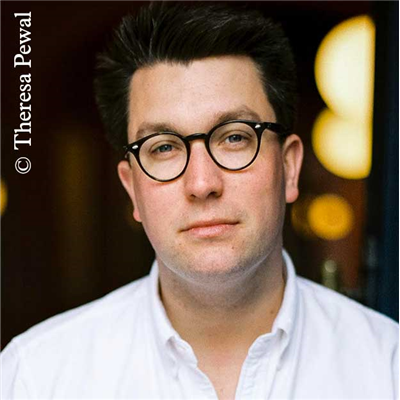 |
Pieter Bruegel: the devil is in the detail. Our early November lecture was given by celebrated Art Historian Gavin Plumley on the early Dutch Renaissance artist Pieter Bruegel. In a confident and virtually wordperfect presentation, Gavin energetically presented the view that Pieter (commonly known as Bruegel the Elder) heralded the transition between the portrait and icon-based art of the preceding centuries and a modernised focus on the social landscape of the contemporary Netherlands at all levels of humanity, including the promotion of detailed natural backgrounds, if necessary shamelessly stolen from all over the Globe. Gavin explained how the Low Countries, and especially Antwerp fostered this revolution in art, with its port, global trading and productive hinterland providing not only the tools and materials, but also modern ideas in philosophy, notably humanism. Pieter Bruegel produced almost 100 works that we know of. Instead of scrabbling in this vast catalogue, Gavin concentrated on a small number of key paintings, notably the calendral sequence housed in the Kunsthistorisches Museum in Vienna (which a previous TASEG holiday visited), showing the seasonal changes in the Dutch rural landscape and the roles and characters of every human. Focal points are hard to find in these immensely detailed paintings, but careful scrutiny will find reminders of mortality, for example the odd gallows and a sharpened scythe. Be warned! The paintings discussed can be seen HERE |
|
| Thursday, 31 October 2024 |
| Christopher Wren and the City Churches |
| Jill Finch |
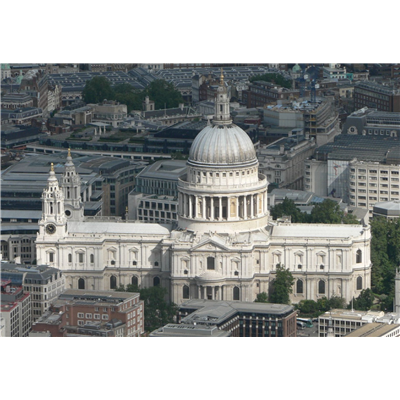 |
Jill Finch is a qualified Guide in the City of London and St Paul's Cathedral and a Guide in the Guildhall Art Gallery. She is an associate member of the Institute of Tourist Guiding and lives in East London. Having worked in almost every corner of London Jill quite simply loves the city, but her particular passion is for its Churches. Sir Christopher Wren was 33 years old and near the beginning of his career as an architect when the Great Fire of London in 1666 destroyed many of the city's public buildings, including 88 of its parish churches. Wren's office was commissioned to build 51 replacement churches and St Paul's Cathedral. Many of these buildings survive to this day; others have been substantially altered or rebuilt. Some others were completely or partially destroyed during the German Blitz of 1940–41; others were demolished for different reasons. Note: This will be a Zoom event starting at 11:00am. Log on details will be made available in good time. |
|
| Tuesday, 08 October 2024 |
| The Art of Survival: Post-Plague Painting in Sienna & Florence, 1350-1450 |
| Helen Dejean |
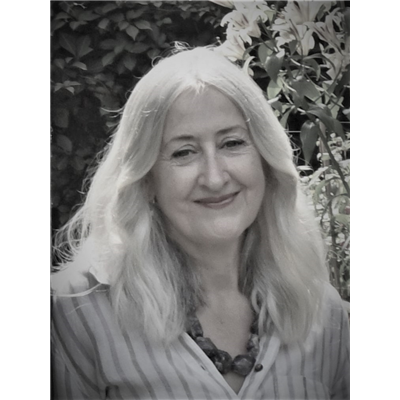 |
Our October lecture was given by the highly expert iconographer Helen Dejean, who focusses on medieval art, both Western and Byzantine. In this talk we examined the effects of the devastating Black Death on mid 14th century Italy, focusing on the contemporary and post-plague pictorial and decorative art of the two cities. Helen compared the effects of the plague to the effects of our recent pandemic. In the same way as the education of our young people was disrupted in the pandemic, so the painting masters and apprentices lost contact or died as a result of the plague. The talk was concentrated mainly on altar pieces and frescoes many of which were highly elaborate and colourful. Pre-plague most of these pieces were two-dimensional and unproportional. Post-plague there was a considerable attempt to make the art works more realistic and the subjects, particularly the Virgin Mary, began to look more human and emotional. A sequence of excellent slides demonstrated the dominance of religious iconography, especially that addressed to the Virgin and the Saints, presumed to be an attempt to ward off the contagion. Helen discussed a number of these in detail, even comparing duplicate or revised versions by the same artist or similar themes by others while we were dazzled by blazes of gold, red and blue on the screen. The background history of the development of the plague and its spread geographically was very interesting and well depicted with coloured maps and directions of travel. The thesis was that the ravages of the plague would have depleted the ranks of artists (as of everybody), allowing new styles and initiatives to emerge. That this did not happen to the extent expected was a matter for enquiry, but perhaps demonstrated a conservatism that lasted into another century. No lecture fails to provide education. We learned a new word, polyptych, a two or three panel creation normally an altarpiece. We also had a brief and unexpected introduction to parasitology. |
|
| Wednesday, 18 September 2024 |
| Handel in London Zoom Lecture |
| Richard Wigmore |
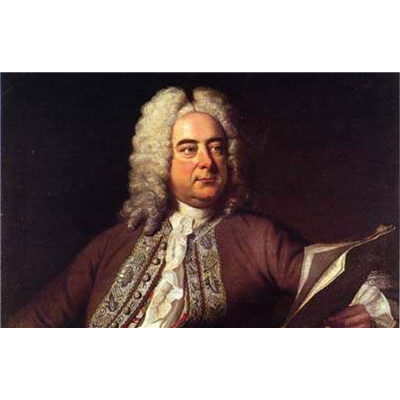 |
By the late 1720s Handel’s operatic fortunes were waning. Yet with indomitable willpower he remained undaunted. Never short of confidence or savoir-faire, the young Handel seems to have set out to become the supreme musical cosmopolitan. After a thorough training in his native Saxony, he honed his command of supple bel canto melody during a three-year sojourn in Italy. He then headed for London, where he scored an immediate sensation with his ‘magic’ opera, Rinaldo. The following year, 1712, the brilliant young Saxon made London his permanent home. He quickly became the de facto resident composer of the Haymarket opera company and a court ‘insider’. Long before he took British citizenship in 1727, Handel was being acclaimed as ‘the Orpheus of our Century’, and Purcell’s undisputed successor as Britain’s national composer. Complementing a biographical portrait of the composer with a discussion of key works, Richard Wigmore’s lecture celebrates Handel’s colourful, often turbulent, career in his adopted land: from his spell as composer to James Brydges, Duke of Chandos, through his fluctuating fortunes as operatic composer-impresario, to his final creative decade, dominated by oratorios for a puritanically inclined audience. |
|
| Tuesday, 10 September 2024 |
| Bound to Learn: A Brief History of Western Bookbinding |
| Caroline Bendix |
 |
Caroline Bendix is a library conservator, accredited through the Institute of Conservation, who has worked on over 500 collections in the UK and abroad, including St Catherine’s Monastery, Sinai, advising on all aspects of books’ care in situ. She has written three of the British Library’s guides on preservation and in 2019 was awarded the Plowden Medal for her “outstanding work in developing in-situ library conservation”. Since 1992 she has been the National Trust’s Adviser on Libraries Conservation, the adviser and trainer for The Arts Society’s Heritage Volunteers projects and is on the Archbishop of Canterbury’s advisory panel for Lambeth Palace Library. This lecture looks at western bookbinding, in particular during the age of the printed book. Aspects of the book trade, including bookbinding practices and materials used in bindings are shown and, as structure and decoration changed as the centuries passed, the individual binders’ fingers tell their own tale as the craft developed. The bookbinding trade has long recycled waste materials, some of which may be more valuable than the books themselves. Bookbindings also provide an insight into the owner’s wealth and station in life, as books were bought unbound and bindings were therefore generally chosen by the first owner until the 19th century. |
|
| Tuesday, 11 June 2024 |
| London: City of Scientific Discovery |
| Aaron Hunter |
 |
London as the Hub of Scientific Discovery: Are Science, Art and Philosophy so Far Apart? Our June lecture was given by palaeontologist, Blue Badge Guide and newly listed TAS speaker Aaron Hunter, who addressed the topic “London: City of Scientific Discovery”. There was nothing naïve about this confident and staccato parade of scientists working in London (too many to detail here), some famous and some less well known, ranging from Robert Hooke, who invented microscopy (the Dutch might challenge this) in the mid 17th century to Rosalind Franklin in the 1950s, whose use of X-ray crystallography enabled her to propose a double helix structure within nucleic acid, which led to Crick, Watson and Wilkins defining and explaining the role of DNA and/or RNA in almost all biological processes. Some subtle themes were evident. The most obviously connected to the lecture title was the thesis that late 17th century architects, led by Christopher Wren, revived geometry and pioneered construction techniques to produce buildings that were great works of art, as well as symbols of growing confidence in the power of human engineering. In parallel, scientists came together to explore and discuss natural phenomena (viz The Royal Society), an essential process that continues unabated to the present day. The growth of London made it the natural choice for scientific congregation (as opposed to Oxford and Cambridge), and crucially attracting scientifically literate migrants and immigrants from abroad, which remains vital today. Scientists were distributed in many institutions before a coalescence in the University of London, the British Museum and the Royal Institution. Faraday emerged as the inventor of practical electrical power. In the 18th century the wide exploration of the Globe resulted in the retrieval and classification of fossils, large and small, which demonstrated that species were not immutable. Hence evolution by non-random reproduction and natural section gradually gained acceptance. We were pleased to hear that Alfred Wallace and Charles Darwin were colleagues and not rivals as commonly supposed, but Darwin obtained prior publication, still a vital play in scientific pre-eminence. I was left with the impression that the Double Helix in some way mirrored Wren’s spiral staircases. For a selection of the images presented, please click HERE |
|
| Tuesday, 14 May 2024 |
| Eric Gill: The Early Years |
| Caroline Walker |
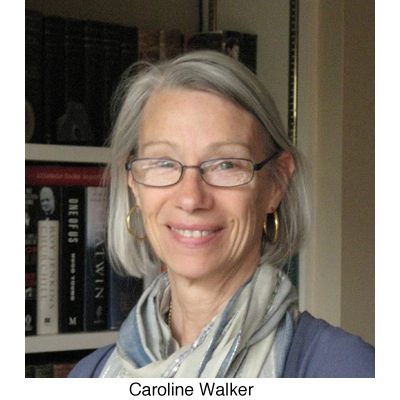 |
Eric Gill: the Polymath Artisan of the 20th Century. Cancel Culture Challenged? Following an impromptu celebration of our Chair’s 80th birthday, our May Lecture by Caroline Walker was a fascinating account of the early life of the English stonemason, wood engraver, sculptor, letter cutter, typeface designer, and printmaker, whose work remains evident across a range of media including familiar typefaces, public buildings, churches, war memorials and funerary monuments. In a crystal clear and well-illustrated talk Caroline sketched the progress of Gill from a poor, but religious, background to national and international prominence through successive (though incomplete) trainings in architecture, wood carving, stone carving, calligraphy and print design, as he came under the progressive influence of contemporary exponents of these crafts, becoming a master of each of them in turn. Throughout Gill maintained that his work was not Art in the traditional sense but artisanal excellence. However, the emotions behind his many creations reveal a trend towards sensual, not to say erotic obsession, mixed with the drift from agnosticism to Roman Catholicism. Caroline hinted at scandals in Gill’s private life, which she tactfully did not document, but which have since led to his work being frowned on in conventional circles and banned in some galleries. On a local note, Gill was born on Steyning and lived productively in Ditchling, where the Museum exhibits much of his work. You can click HERE to view some of the illustrations presented in the lecture. |
|
| Tuesday, 09 April 2024 |
| The Talent in Tite Street |
| Jennifer Toynbee-Holmes |
 |
The talents and the rivalries in a late 19th century Chelsea street Our April lecture was given by Jennifer Toynbee-Holmes, a widely experienced art lecturer, media director and tour guide on “The Talent in Tite Street”. This thoroughfare connects the centre of Chelsea with the Thames Embankment, and for more than a century has been home on occasions to a very long list of artists and socialites. Names that come to mind are John Singer Sargent, James McNeill Whistler, Augustus John and, of course, Oscar Wilde, but many more including, amazingly, Mick Jagger! The question that arises is why do artists congregate together? The textbook answer is that in doing so they advance and protect changes in social mores and liberisation, which is their intention, but their private lives were widely seen as scandalous. Did this help their cause? In addition, rivalries arose between them, with as at least a century before, portrait painters of the rich and famous prospering while avant-guarde artists often fell into poverty. Yet they all lived together and hated or admired their neighbours, as the case may be. Has anything changed? |
|
| Tuesday, 12 March 2024 |
| Wilde about Oscar: famous for being Famous (& Infamous) |
| Simon Whitehouse |
 |
The Importance of being Oscar Wilde Our March lecture was delivered in robust and entertaining manner by former actor Simon Whitehouse on “ Wilde about Oscar: Famous for being Famous (and Infamous)”. Simon’s training on the Stage was evident in the manner and clarity of his presentation, punctuated as one might expect by examples of Wilde’s humour, anecdotes and piercing satire, which leavened what might have been a tricky subject for an older and more conservative audience, but we all ended laughing. Just the balance that TAS wants to achieve. The lecture focused on the background to Wilde’s career: his family pedigree, early years and rise to international stardom as a celebrated raconteur, author and playwright, arguably unsurpassed since Shakespeare, a bold proposition. Then followed the dark side about his homosexuality (arguably bisexuality), seen in the light of late Victorian values (and legislation), hypocritical as these might now be perceived, and Wilde’s descent into infamy and imprisonment. Happily, Simon limited this to the very last part of his lecture, so we were left with, arguably, the proposition that Wilde’s legacy grew after his death, and continues to do so. ‘Twas ever thus in the Arts. Some of the images presented can be seen HERE |
|
| Tuesday, 13 February 2024 |
| The Italian Job - A Contemporary Figurative Artist in Calabria |
| Richard Whincop |
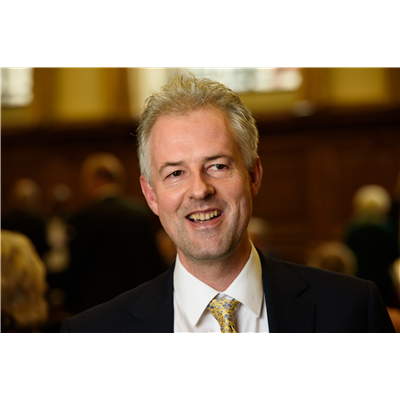 |
Contemporary street art in an ancient setting. An agreeably warm story on a wet winter’s day. Our February lecture featured acclaimed British artist Richard Whincop, on the somewhat enigmatic subject of “The Italian Job – A Contemporary Figurative Artist in Calabria”. Forget Michael Caine, what we heard was an exposition of a branch of modern art termed “figurative”. This was not defined, nor was it Richard’s intention to do so, but he used the tale of a decorative project in Italy to illustrate the genre. The lecture itself was relaxed, well larded with gentle humour and informative. The images were slightly fuzzy and some of us might have wondered if we needed to go to Specsavers, but perhaps it is all part of the concept of this form of painting. The style attempts to push the background slightly away from the human figures, which are thereby brought to life. The story focused on Cosenza, the major city of Calabria at the very foot of Italy, with Greek and Byzantine origins, and the Norman conquest of Calabria, and eventually Sicily, that took place in the 11th and 12th centuries. The project brought together a team of artists to recreate moments and scenes in Calabria in the High Middle Ages, which were subsequently displayed on street walls in the city. The paintings, on giant canvases and produced after intensive research, were far from abstract as we usually conceive it, but true to life, with artistic licence and every kind of modern technology employed to bring life into otherwise static human figures, notably facial expressions. We also learned that Roger II, a late Norman king, presided at the time in Sicily over the most eclectic Court in Europe. Richard admitted to being mischievous, to the extent of painting the facial features of two leading figures as Benedict Cumberbatch and Brian Blessed. Anyone who remembers Brian Blessed in Z Cars is old enough to qualify automatically for TASEG membership. Images of Italy are always welcome on a wet day in East Grinstead, whatever the season. But we also learned a lot. Richard Whincop is a professional artist who graduated in English and Art History from York University in 1986. From 1988-1994 he lectured at the adult education departments of Glasgow and Strathclyde Universities, and then went on to become a full-time figurative artist, executing large-scale public commissions, and exhibiting widely throughout the UK. He now lives and works in Chichester, West Sussex. You can read more about Richard and his work HERE |
|
| Tuesday, 23 January 2024 |
| The Art of the Cartoonist |
| Harry Venning |
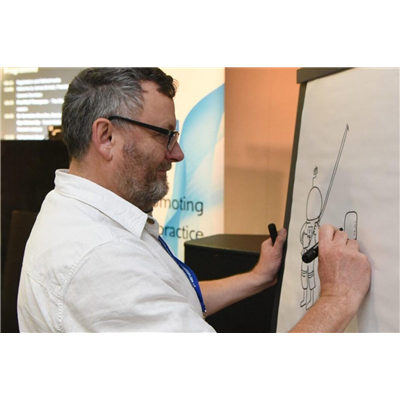 |
Variations on a theme from Hamlet (Act III, Scene I), that is the question. Or was it? Proposition: Jug Response: Toby or not Toby? And many gags just like it. Our January lecture was surely the most extraordinary TASEG has ever hosted. Harry Venning, an actor, comedian, cartoonist and above all a brilliant entertainer, presented “The Art of the Cartoonist”. Striding the stage with contagious confidence, he set up technology we have never seen before: drawing live on a flip chart projected onto the big screen. There were some wobbles, but nobody minded. We were too busy laughing. What a fillip on a dull wet winter’s day! And a record post Covid attendance in the theatre. For those who were paying attention (rather than waiting for the next joke), the serious narrative was a history of cartoons (also known as sketches) from Leonardo da Vinci through Gillray, Leech, Shultz to numerous modern practitioners (not excluding talented women), many of whom struggled to become established before their talents were recognised and accepted by the stuffy Middle Classes and newspaper proprietors. The essence of a cartoon, we were convincingly taught, was to condense a story into relatively few strokes of a pen, with the flexibility to alter the character of the persons portrayed with even fewer strokes. Converting humans into animals is also effective. Does anyone remember Rupert Bear in the Daily Express? Of course, Harry reviewed the role of cartoons in political satire, and in demonstrating social divisions and human eccentricities, showing that this has not really changed in two centuries. For this very reason they remain popular and are the first choice when readers open newspapers and magazines. Proposition: Two ladies worried about their weight. Response: Tubby or Not Tubby? For a short selection of images, please click HERE |
|
| Tuesday, 28 November 2023 |
| Christmas in Bach's Leipzig: The Christmas Oratorio of 1734/35 |
| Sandy Burnett |
 |
An outstanding presentation, a singalong and a German lesson! Our final lecture of the 2023 season featured Sandy Burnett, a broadcaster, scholar, author and self-confessed enthusiast for Baroque music, notably that of J. S. Bach. In an outstanding and highly professional presentation he (arguably?) made the case for Bach being the greatest composer of all time, in relation to the musical environment(s) which Bach encountered and which he advanced so far that his compositions can only be regarded as a work of genius, though not immediately recognised in his own lifetime. A notable feature of the Oratorio was the use of the human voice as an instrument integrated into the overall composition. The evidence was focused on the Christmas Oratorio, which in one hour was dissected into so many pieces that even TASEG oldies could vaguely comprehend the significance of musical notation, to say nothing of counterpoint, alto soloists and Basso Continuo. We were encouraged to sing together a number of short melodies, familiar to most of us, and then (horror of horrors) sing the lines in German. Actually, the response from the audience was passable, so there is still hope! It must be Christmas, to judge by the flavour of the meeting, the raffle and the seasonal social gathering afterwards. The lecture featured portraits of eastern German cities where Bach found work, especially where it fitted in with Lutheran theological notions, translating the Word of God into everyday speech and adding in popular tunes with modernised lyrics. Leipzig, Weimar and Dresden were mentioned as tourist destinations TASEG members might care to explore, of special interest to organists, whose cause in church worship Bach greatly advanced. |
|
| Tuesday, 14 November 2023 |
| Tantrums and Tiaras |
| Nigel Bates |
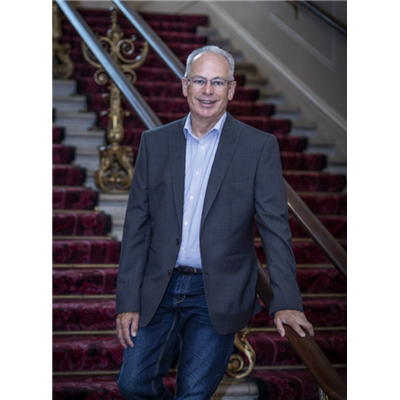 |
Nigel Bates has been a performer for more than forty years in and out of the Royal Opera House Covent Garden, including seventeen years as Principal Percussionist with the Orchestra and eight years as the Music Administrator of The Royal Ballet. In the course of over 6000 performances, broadcasts and recordings he has worked with many of the leading figures in the classical music industry and brings his experience, observations and reflections - both as a player and as a manager - on the unique world of the performing arts and artists. After living for two years in Australia, including a stint as General Manager at 2MBS, Sydney's fine music broadcaster, Nigel returned to the UK to resume his music and speaking engagements across the country. He was a producer for both the BBC's Maestro at the Opera and Pappano's Classical Voices television documentary series, subsequently being appointed to the position of Music Administrator for The Royal Ballet. He continues to work as a percussionist and lectures widely for The Arts Society network. There is nothing better than a lecture given on a topic in which the lecturer, in this case Nigel, has extensive knowledge, insight based on many years experience and a delightful way of delivering his subject. We gained a great knowledge of the history and operation of the Royal Opera House with insights into the backstage, under stage, wings, lighting and scenery. We learnt about front of house, auditorium, decoration and orchestra pit. We discovered rehearsal rooms, music rooms, the extraordinary number of pianos all of which occupy a two and a half acre site. Fascinatingly, we also found out about the ups, the Tiaras and the downs, the Tantrums. Nigel mentioned many famous people who had performed at the Royal Opera House either in Opera or in the Royal Ballet. We were told about their highly amusing mistakes, foibles and yes tantrums. We found out about the work of the 2000 permanent employees of Covent Garden the set constructors and designers, the lighting crew, the coffee makers, the makeup artists, piano players, costume designers and makers. We learnt about the complex timetable for rehearsals and the work of the maestro backstage who sat with his complicated communication devices controlling everything and everyone concerned with the performances. All of this was delivered by Nigel in a very engaging manner. He had an extremely dry sense of humour and regaled his audience with anecdotes of famously difficult performers and backstage catastrophes. Chuckles, oohs and aahs rippled round Chequer Mead auditorium. It was obvious that this was a lecture enjoyed by all. Many members I spoke to afterwards had thoroughly enjoyed themselves, as did I. Later that evening as I wandered round Covent Garden with some of my family, I realised that I had gained a whole new perspective on that area of London. I have to say London was magical that night and was embellished by beautiful Christmas Decorations. Nigel had set the tone for a thoroughly enjoyable day. |
|
| Tuesday, 10 October 2023 |
| Entertaining Angels Unawares - Angels in the Bible, Music and Art |
| Patrick Craig |
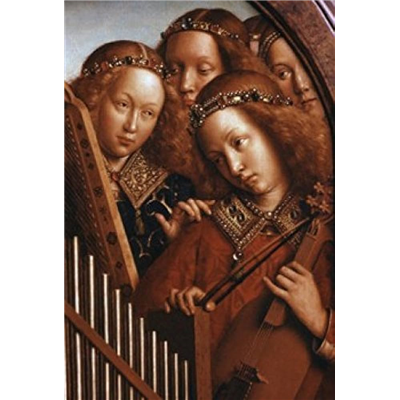 |
Patrick Craig is a Vicar Choral at St Paul’s Cathedral. For twenty years he combined this with an international career singing over a thousand concerts with the world-renowned early music consort The Tallis Scholars. He also sings with the award-winning group The Cardinall’s Musick. He founded and conducts the country’s leading all-female professional choir, Aurora Nova. Talking to some of our members after our lecture, I gained the impression that this could be categorised as a ‘Marmite’ lecture. Fortunately most of our members seem to love Marmite so my write-up will reflect my personal views and, I’m pretty sure, most of theirs. Patrick was mesmerising. His outfit was very unusual and, I’m sure, not worn for his day job at Saint Paul’s Cathedral. This was a lecture which brought together many different strands. The Choral Music was of the very highest quality and had one completely engrossed. You could have heard a pin drop in the Auditorium. It was magnificent or should I say Magnificat. We were treated to a woven tapestry of beautiful paintings and sculptures of Angels from Tintoretto to Epstein, Art History, Poetry and Architecture. There was ‘Angelic’ music from Purcell to Sarah Macdonald. There were choirs from the great cathedrals and Patrick’s own all female choir, Aurora Nova. Of course we also heard Patrick’s beautiful countertenor voice and also the voices of our members singing an Alleluia chorus by Judith Weir. Well done everyone for entering the spirit of the occasion. This lecture was delivered with charm, extensive knowledge and humour. The slides were of very good quality and the music filled the auditorium and, considering the tracts were stored on the computer, was also of a similar quality. Needless to say, I felt completely moved, in fact on Cloud 9. I’m not sure what category of angel I landed next to! |
|
| Tuesday, 12 September 2023 |
| The Archeology of Crossrail |
| Leo Heaton |
 |
Tales of the Underworld. Our first meeting of the resumed 2023 season began with an efficiently run and harmonious AGM. We were then treated to a stunning lecture by London Tour Guide and, by her own admission, budding commentator on London excavations Leo Heaton on “The Archaeology of Crossrail”. In a cheerful and engaging style, she managed to merge engineering with a curiosity about the way of life of Londoners, as far back as the Mesolithic and as recent as the 19th century (and not excluding the sanitary habits of Victorians!). We leaned that discarded rubbish (we might recognise this in some cases as clutter) and skeletons of humans from plague pits and other burials could illuminate the way of life in times past. That most of the items recovered in excavations were everyday items actually enhanced the study rather more than the discovery of spectacular treasures, though a few of the latter were found. We saw beautifully constructed graphics illustrating the maze of tunnels beneath London, including Tube Lines, sewers, water mains, power distribution cables and the Post Office Railway. To this is now added Crossrail. The tunnelling rules imposed were strict, with access shafts rather than open digging being required in the most sensitive areas, especially the City of London. Where items of interest were found, by law work was paused while archaeologists meticulously excavated the site. A boon for this profession. Engineering at an Arts Society lecture? Nobody left early. For a selection of images presented, please click HERE |
|
| Tuesday, 13 June 2023 |
| O For the Wings of a Dove - The Life of a Cathedral Chorister |
| Roger Askew |
 |
The last lecture of the season was given by musician and former educationalist Roger Askew on an unusual topic: “O for the Wings of a Dove – The life of a Cathedral Chorister”. Speaking lucidly from personal experience and with surprising humour given the topic, he painted a compelling picture of the discipline required to meet the schedule of daily offices (i.e. services), and the competitive nature of the chorister trials to find not only the sweet voice but also the musical talent of prospective probationers to match the professional (gentlemen) singers behind them dealing with the lower parts. In most cathedrals the young choristers are educated in special schools along what are basically, but perhaps necessarily, public school lines. Examples were given of how this early musical education led to prominent concert success in later life. We also heard how church music evolved from the 12th century to the present, from plain chant through polyphony to modern compositional extravagance, including the impact of descants, and the admission of girls into cathedral choirs. Old fogies can take comfort that the impact of the latter on the traditional English Cathedral sound is not eroded, we were assured. The talk included numerous sound bites, sadly too short, but one hour is one hour and there was a lot to cover. We heard about the golden age of English polyphonic choral music under Tallis and Byrd, the decline after Purcell and then the slow revival in the 19th century begun by Frederick Ousley, but leading to such greats as Parry, Vaughan Williams, Britten and Elgar. An excellent talk, and very uplifting. For a selection of images presented, please click HERE |
|
| Tuesday, 09 May 2023 |
| Castles – The Unquenchable Thirst of William Randolph Hearst |
| Mark Meredith |
 |
Mark Meredith is a writer, the founder of HouseHistree.com, and lectures regularly at societies, festivals and clubs in both Europe and the United States. After leaving Stowe School, Mark worked for twenty years as a plumber in London. However, his real passion has always been for history, particularly the history behind houses through the characters that conjoin to create them. His special interest lies with the great American houses and their relationships with those in Europe, both socially and architecturally. William Randolph Hearst had an obsession: In 1935, Forbes Magazine called him, “quantitively the world’s number one collector of Objets d’Art” and when he died The New York Times stated that during the 1920s and 30s, he alone had accounted for 25% of the world’s art market activity. But to where was this king’s ransom headed, and hoarded? Some of you will already know of Hearst Castle in California, but lesser known is his 5-story Gothic castle hidden within a Manhattan apartment block; his weekend home on Long Island that inspired the castle in The Wizard of Oz; his sprawling 12th century castle in Wales with its own ghosts; and, the Bavarian village he built around his mother’s 7-story schloss deep in the forests of Northern California. Through the unparalleled extravagance of the places he lived in and loved, we’ll take a dive into the extraordinary life of the man who Orson Welles famously satirized as Citizen Kane - the same man who changed the face of journalism forever and built 'the greatest publicity machine in history', but died paying rent to his creditors. |
|
| Tuesday, 11 April 2023 |
| The Power of Photography |
| Roger Mendham |
 |
What is better than an outstanding lecture? Well, an outstanding lecture that lasts 59 Minutes and 42 seconds and not a moment longer, allowing time for a stream of eager questions from the floor. This is what we were to treated to by acclaimed photographer and accredited Arts Society speaker Roger Mendham, on the subject of “The Power of Photography”. In a relaxed presentation accompanied by riveting images, Roger subtly contrasted the relatively immobile projections of human and animal life provided by painted art with the ability of the camera to capture accurate instant, but then lasting, representations of humanity and nature in all its momentary states, whether joyful or tragic, records of history or staged political propaganda, or merely snapshots of ever-changing fads and societal obsessions. Large mammals excepted: their morphologies were finally defined. Numerous classic and recent photographs were shown, many familiar to our membership, perhaps showing our ages! But Roger’s interpretations of their purpose and significance was an eye-opener, too many individual cases to list here, although those of us who have recollections of WW2, the Fifties and the Swinging Sixties might have felt the odd twinge of nostalgia. The question and answer session after the lecture mainly addressed technical issues: colour vs monochrome, film vs digital and mobile phones vs expensive specialist cameras. Let nobody say The Arts Society is behind the times. For a selection of the images presented, please click HERE |
|
| Tuesday, 14 March 2023 |
| Beautiful Houses - Frank Lloyd-Wright. America's Greatest Architect |
| Dr Anne Anderson |
 |
Nice house – if you can afford it! The March Lecture was given by the highly reputable free-lance speaker Anne Anderson, whose portfolio of talks across the whole range of the Fine Arts is truly amazing. Her subject was “Beautiful Houses – Frank Lloyd Wright. America’s Greatest Architect”. In a staccato presentation, with first class illustrations and a fund of information novel to most of the audience, Anne traced the development of his radical approach to design, rigorously thematic at all levels ranging from building design to interior décor, furnishings and integrated artwork (notably Japanese), and the acclaim and patronage that it subsequently attracted in America from the end of the 19th century right up to his death in 1959. Many classic Lloyd Wright houses were illustrated in detail, notably those in Oak Park, Illinois, but of course his portfolio extends much more widely, to churches and public buildings elsewhere, necessarily the subject of another talk. The thesis was that Frank Lloyd Wright was influenced by his Unitarian upbringing, albeit in a somewhat dysfunctional family, and indeed dysfunction continued in his own marriages and other relationships. Other influences were the Arts and Crafts Movement, and contemporary architects notably Charles Rennie Macintosh, also the designers and authors William Morris and John Ruskin, and perhaps other tides in artistic modernism. How to summarise in a single paragraph his concept of ideal contemporary housing for the very rich is a challenge. Only the rich could meet his strict prescriptions for thematic uniformity in all aspects of external and internal design, furnishing and décor, but they seemed eager to adopt them. Open space and minimal partition was perhaps a precursor of modern concepts of working spaces in many settings. For a selection of images shown, please click HERE |
|
| Tuesday, 14 February 2023 |
| Banksy - Fraud or Genius |
| Pepe Martinez |
 |
Now you see it, now you don’t. On a wall near you, but not in any conventional gallery. Is this the end of art as we know it? The February lecture was given by London Blue Badge Guide and Urban Art enthusiast Pepe Martinez on the intriguing subject “Banksy – Fraud or Genius”. In a robust and highly entertaining talk, which delighted the audience despite the uninhibited subject matter and occasional basic language inherent in the work discussed, Pepe chronicled the rise of Banksy from virtually derelict status to international star, whose work can fetch millions despite the artist’s attempts to subvert conventional markets. We also learned something of the techniques employed in stencilling so called “graffiti” very rapidly in public places, the history of such improvisations in the late 20th century, the fury of professional art critics, and the lifestyle and incomes of Banksy himself, who largely retains anonymity. It was pointed out that much of the money his work earns goes to charity. Many of the images are well known, but quite difficult to include in a post like this, as they are protected by copyright or high pricing: part of the conundrum that is Banksy. However, his first iconic work: a girl with a balloon, can be reproduced: As well as the denouement, when this work was shredded by a device hidden in the frame after being sold at auction for a million or so. So what to make of this modern day rebel, who has so disturbed the Art Establishment? Iconoclast, certainly. Upstart, certainly. Hero, apparently. Subversive, some would agree. Modern artist, who knows? 2 of Banksy's works can be viewed HERE |
|
| Tuesday, 24 January 2023 |
| Never Mind Quantitative Easing, Show us the Bling: A Peep at the Bank of England's Artworks |
| Tim Kidd |
 |
The first lecture of 2023 was given by London Blue Badge Guide Tim Kidd on the subject of “Never Mind Quantitative Easing, Show us the Bling: a Peep at the Bank of England Artworks”. In preliminary remarks our Chair announced that post-Covid TASEG membership was now 348 and climbing. Places are still available, and the 2023 schedule of lectures is enticing. The lecture was delivered in a very direct, personal style, with humour which helpfully took the edge off a topic which might have been seen as very serious, and thereby made it assimilable. The speaker measured the duration of his talk with a visible kitchen timer, a TASEG first, and perhaps to be recommended to future lecturers. He obligingly stopped as soon as the bell rang after one hour! Further, he assured us there would be no financial politics. Of course, there were some, but presented in the context of economic history and therefore a helpful adjunct to the catalogue of the artistic treasures which the Bank represents in its very physical structure, as well as its acquisitions. An unacknowledged gem? We heard that the Bank had been founded in 1694 and physically built by John Soane as a first place for financial accounting to be practised, investment facilitated, and dividends collected to relatively uniform rules. In the 18th century the original building was replaced by a grander structure, rebuilt again in the 1930s by Montagu Norman. The architecture is classical in almost every respect, from doors to pinnacle statues, and 18th and 19th century in internal décor, including painted portraits. This was all illustrated, including the silverware, mosaics and sculptures retained and displayed in the Bank Museum and elsewhere. Tim’s definitions of Art extended from gold bars, architecture, sculpture, through 19th century painting, to modern bank notes, and indeed forgeries. Food for thought and very catholic in concept. We were also advised of the public accessibility of the Bank interior itself, as well as attendant and outlying Museums. For a selection of images presented, please click HERE |
|
| Tuesday, 29 November 2022 |
| The Elgin Marbles |
| Dr Stephen Kershaw |
 |
Our Christmas lecture and social were held at the end of November. There is now a winter interlude while Chequer Mead hosts their Pantomime and carries out the annual safety audit of the auditorium. We will resume in late January, when our 2023 programme begins. We welcomed classical scholar Steve Kershaw to present a lecture on “The Elgin Marbles”. Steve has “previous”, having given us a superb Special Interest Day a while ago, which set the scene and whetted our appetite for the recent holiday in Italy, visiting “The Cities of Vesuvius”. We were not disappointed, either by the holiday or the lecture today. The title (The Elgin Marbles) advertised a topic that would be recognisable and, in view of the periodic controversy concerning their proposed return to Greece, appealing. What we got was remarkable: a scholarly review of the architecture of the Parthenon and its many associated sculptures and friezes (those in place, in the modern adjacent museum or in museums elsewhere), but delivered in a light style, often humorous, which focussed our attention on details and interpretations we might not have considered before. Interpolated into all this, and building almost like an orchestral crescendo, was the chequered history of the Parthenon itself, and its successive guardians over the centuries: Greek and then Roman pagans, Christians, Muslims, and finally Greeks (the last in modern times) whose sequential neglects and vandalisms over the centuries nearly extinguished the monument as an icon of Western Civilisation. Culminating from all this, the question was, of course, whether all the artifacts should, or could, be reunited together in one place, the modern Greeks now leading the charge. Enter Lord Elgin in the very early 19th century. Not at all the only English or French 18th and 19th century followers of ancient civilisation, but the one most vilified. The common feeling was that the elegance and skill of ancient art should be recognised and, for the protection of the artifacts, preserved in other places in Europe. Or were they trophies? It’s not clear. Elgin was perhaps lucky in negotiating permissions, possibly dubious, from the Ottoman Turks, who ruled Greece at the time, but has suffered posthumous damage to his reputation. Steve moderated the discussion professionally, pointing out the moral, diplomatic and legal issues involved in any scheme for reuniting all the widely dispersed artifacts in one place, and wisely declined to side definitely with one of the arguments or the other. For a selection of images discussed, please click HERE |
|
| Tuesday, 08 November 2022 |
| Mad Men and Artists - How the Advertising Industry Exploited Fine Arts |
| Tony Rawlins |
 |
The first of our November 2022 lectures featured former Advertising Executive and active Arts Society member Tony Rawlins, speaking on “Mad Men and Artists: How the Advertising Industry Exploited Fine Arts”. At the outset he explained that “Mad Men” referred to the natives of Madison Avenue in New York, and not random lunatics, but as the talk went on we might have wondered whether at least in some cases, artistic skill, radicalism and advertising creativity were somewhere on the same spectrum from insanity to genius. What followed was arguably the most outstanding presentation of the year: fluent, confident, staccato, stunningly well informed, excellently illustrated and above all humorous. In fact, were we not the (somewhat) stuffy Arts Society, we would have been rolling in the aisles. The prefect antidote for a grey rainy Autumn morning. Tony started with a description of how the advertising industry works, explaining how crucial it is to identify a target audience and then exploit their particular expectations and vanities, but not excluding deliberate exaggerations (illustrated from Van Eyck, Gainsborough, David and others). Good ads therefore appeal not only crudely to personal ambitions in an acquisitive world, but also to individual concepts of societal status, and then in the case of long running products (soaps, detergents, cigarettes, beverages, cars) the intellectual challenge of recognising inherent linkages to subliminal icons as the ads become more abstract. At this point we were introduced to Michelangelo’s David and a host of other well known classical images which have served as models, though not exact copies, for modern (i.e. 19th and 20th century) advertisements in mass media. The list was extensive, ranging from Millet (Pears soap) to Art Deco (numerous illustrations) and artistic modernism (even Tracy Emin, prospectively). The talk concluded with optimism about the fidelity of young people to the role of Fine Art in modern life, which affiliated the entire lecture to the overall aims of The Arts Society and, to please most of us, a discussion of the global merits of Guinness! |
|
| Tuesday, 11 October 2022 |
| Charles Saatchi: A Modern Medici |
| Barry Venning |
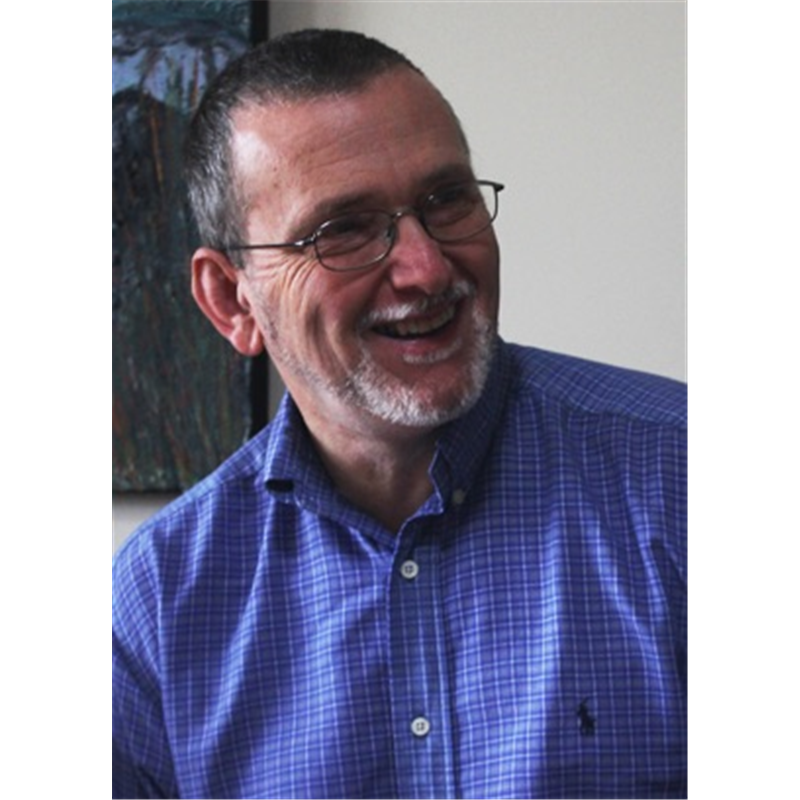 |
Our October speaker was Art Historian and university teacher Barry Venning. Barry takes his Fine Arts students to Galleries and museums, so is in touch with the younger generation, who are our future artists in the front line of modern trends. His title was “Charles Saatchi: A Modern Medici”, although by his own admission the Medici received little attention, except as a standard by which to judge modern benefactors. Who would have thought that we could start our season with two lectures on modern art without emptying the lecture theatre? Yet with Barry we were informed, educated and amused all in one go. In a fluent and humour filled talk we heard briefly about Saatchi’s meteoric progress in the advertising industry, with which profits he set out to promote modern art, initially and as it turned out predominantly, sculpture (in the widest sense), but also painting (again, widely interpreted with all manner of materials in use, some bizarre). The picture of Charles that emerged was one of a philanthropist who was also an astute businessman, who eventually was in the position where his imprimatur, but way of buying a new work, guaranteed the subsequent success of the artist. A position of considerable power, but broadly for the good. We were treated to many images of modern art, some familiar and others largely unknown outside the small but supercharged world of art dealing. Clearly taste is a matter for individual adherents and experts alike. The Arts Society does not pass judgement. For a small selection of images displayed during the talk, please click HERE |
|
| Tuesday, 13 September 2022 |
| The Body as a Place: The Sculpture of Antony Gormley |
| Anna Moszynska |
 |
The new TASEG season opened in September with a smoothly handled AGM and an exciting lecture by Art Historian Anna Mosynska on the work of a distinctly modernist sculptor under the title “The Body as a Place: The Sculpture of Antony Gormley” Anna approached an obviously challenging topic with aplomb and a pleasantly engaging style, to win over an audience that might have been sceptical about this artist, who is quite commonly ridiculed, and she succeeded in explaining the journey Gormley has made from a would-be Buddhist monk to a world- famous creator of huge sculptures requiring not only their own rooms, but sometime their own halls and ultimately whole galleries to accommodate them, forming an almost exponential curve of magnitude. She explained how the human body form remains a central theme in all the sculptor’s creations, from early drawings and representations, often using unusual materials (such a dried bread!), to all manner of metallic representations in all manner of different settings, not excluding the ocean. Finally, we moved gently into quantum physics and IT, to explain how Gormley kept in step in his creations with science and technology. A part of quantum theories is that every particle in the Universe has a small chance of reappearing anywhere else, hence when they all came together the present Cosmos was formed. Astonishingly, Gormley’s more recent works illustrate this concept and take advantage of computer technology to simulate the many randomised connections that could exist between our human bodies and the wider Universe. Cerebral stuff! But The Arts Society exists to expand our horizons. For a selection of images from the lecture, please click HERE |
|
| Tuesday, 14 June 2022 |
| Romancing the Rails: British Railway Posters: On Track with the World's Best |
| Charles Harris |
 |
The last TASEG meeting of the season featured Charles Harris, an internationally known and acclaimed expert on advertising and also a TAS member, who spoke on “Romancing the Rails: British Railway posters: on Track with the World’s Best”. This was perhaps a surprising tack for an arts lecture, but Charles also has a keen eye for the progressions of painting styles in the fine arts from the mid 19th to the mid 20th centuries, and how these influenced railway and other advertising in general, before the predominance of rail travel became over-shadowed by the motor car. An unexpected revelation was how many celebrated fine artists were commissioned to compose images of landscapes, seascapes, heritage sites and even technical subjects, but made subservient to the commercial purpose that their products must sell prospective holidays to the emerging classes who had money and ambition to spend on them. Charles revealed that railway posters are much sort after, and there is a brisk market (so it’s difficult to find many that can be shown here copyright-free). However, the categories of images we saw included those of countryside and seaside landscapes, railway line extensions and viaducts, locomotive transitions to greater power and elegance, the element of luxury in rail travel, speed in reaching desirable destinations, industrial supremacy in relatively remote parts of Britain, and even the (questionable) sub-tropical delights of southern beaches. Overall, a lecture that reminded many members of their childhood (well, especially men), when we worshipped steam! After the lecture the Society held a picnic on the lawn at East Court, in brilliant June sunshine. The Society exits for social purposes, not just for arts education. Please click HERE to view a selection of the posters discussed on the day. We now have a summer recess. The AGM and next lecture will be on 13 September 2022. |
|
| Tuesday, 10 May 2022 |
| The Subtle Science and Exact Art of Colour in English Garden Design - Why Gardening can Rank as a Fine Art |
| Timothy Walker |
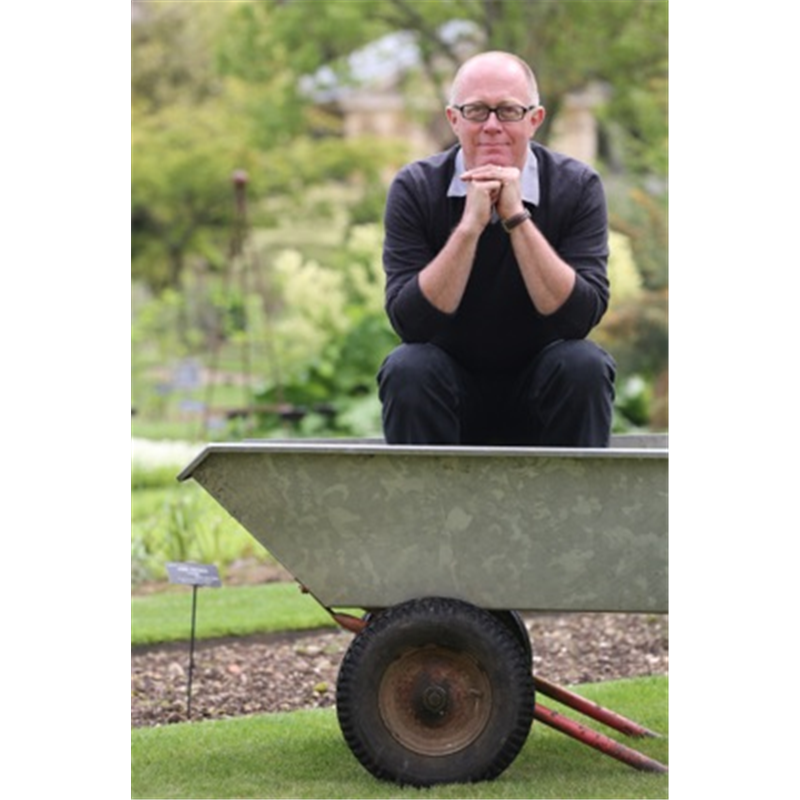 |
The May lecture was given by Timothy Walker, whose lectures on Horticulture and Garden Design are popular with The Arts Society and other organisations all over the world. He has given 1,500 public lectures as part of his work as director of the Oxford University Botanic Garden from 1988 to 2014. Since 2014 he has been a college lecturer and tutor at Somerville College Oxford. Botanic gardens are often described as living museums, and garden curators lecture about them in the same way as museum curators talk about their collections. The title of the talk was “The Subtle Science and Exact Art of Colour in English Garden Design – Why Gardening Can Rank as Fine Art”. Despite this mouthful the quickfire and wonderfully illustrated talk explored the conceptual links between late 19th and 20th century concepts of visual art, and especially the transitional emphasis on colour rather than form, for which the garden border provides an unexpected and possibly unwitting canvas. The lecture was generously larded with humour, but we didn’t escape from mild doses of physics, plant biochemistry, meteorology and perceptual psychology, though these didn’t in any way dull the enjoyment of the presentation, which brightened the day. Keen gardeners will need to re-think their choice of colours in ensembles of border plants! For a selection of illustrations from the lecture, please click HERE |
|
| Tuesday, 12 April 2022 |
| Gold of Gods - Treasures of South America and the Search for El Dorado |
| Chloe Sayer |
 |
Chloe Sayer is a freelance specialist in the art and culture of Latin America. She has lectured in the UK, Canada, Ireland, Mexico, Australia and New Zealand and has curated exhibitions, and assisted on TV documentaries for BBC and Channel 4. Additionally, she has made collections in Mexico and Belize for the British Museum, and is Research Associate in the Department of World Cultures at the Royal Ontario Museum In a talk of exceptional clarity, and beautifully illustrated, Chloe showed us examples of the surviving exquisite goldwork, demonstrating religious devotion, social status and personal decoration at almost all social levels, which the Spaniards discovered on their incursions into (modern day) Colombia and Peru in the early 16th century, and subsequently pillaged. We also saw beautiful woven fabrics and stout lasting architecture which showed how advanced the native civilisations were. The emphasis in the lecture and subsequent questions was on the use of gold and weaving to express the finest artistic instincts, totally comparable with the achievements of the European world. On an unusual tack, Chloe described the integration of native and Spanish cultures which followed in the centuries after the arrival of the invaders. Overall a most informative and thoughtful lecture. A selection of illustrations from the lecture can be viewed HERE |
|
| Tuesday, 08 March 2022 |
| August Rodin and 19th Century Sculpture |
| David Worthington |
 |
David Worthington has been drawn to abstract sculpture since seeing a Barbara Hepworth in a school history book aged 10. He graduated from Oxford University in 1984 with a degree in Philosophy and Theology, then studied fine art in London, Barcelona and New York. He also curates and writes about art. He was shortlisted for the Jerwood Sculpture Prize in 2009. In a detailed, insightful and well illustrated talk David took us on a journey through Rodin's life from his upbringing in a poor Parisian suburb in the 1840s to international acclaim in the early years of the 20th century. His main contribution was presented as facilitating the evolution of sculpture from neoclassic principles to a new naturalism in which the subjects modelled were not gods but everyday people, or else notable figures in current (generally French) society, but in each case portrayed in minutely observed anatomical detail. We also learned about Rodin's complicated personal life. David's thesis was that Rodin heralded and indeed was part of the transition to modernism in many parts of the Arts, but there were limits. On being asked at the end of his life what he thought of the First World War, Rodin is reputed to have said "well at least it may kill off the Cubists". Some of the works discussed in the talk can be viewed HERE |
|
| Tuesday, 08 February 2022 |
| Cosmonauts and Cotton Pickers - Soviet Central Asian Mosaics and Public Art as Propaganda |
| Chris Aslan Alexander |
 |
The February Lecture was given by the much travelled TAS accredited speaker Chris Aslan Alexander, a man uniquely qualified by his upbringing, many adventures and linguistic skills to speak on "Cosmonauts and Cotton Pickers: Soviet Central Asian Mosaics and Public Art as Propaganda". The colourful and quickfire talk covered a lot of ground, but was basically divided into two parts. In the first he reviewed the Soviet campaign of poster propaganda imposed on the non-Slavic Asian countries/provinces in the first decade or so after the Bolshevik Revolution. The art is impressive, though largely anonymous, but can be seen as undermining the traditions of largely Muslim tribal communities, despite a strong emphasis on the emancipation of women and the poorest underclasses. In the second part we heard about the art of mosaic tiling, learned from Islamic pioneers and then widely employed in Central Asia as wall decorations, but subsequently incorporated into Soviet propaganda with the renewal of traditional skills. On this theme we also heard of the contemporary revival of carpet making and even embroidery. We learned a lot, not least about the geography and history of this part of the world, largely unknown to us, but clearly worthy of our attention, not least in the current geopolitical context. Some of the images displayed can be viewed by clicking HERE |
|
| Tuesday, 18 January 2022 |
| Peggy Guggenheim |
| Alexandra Epps |
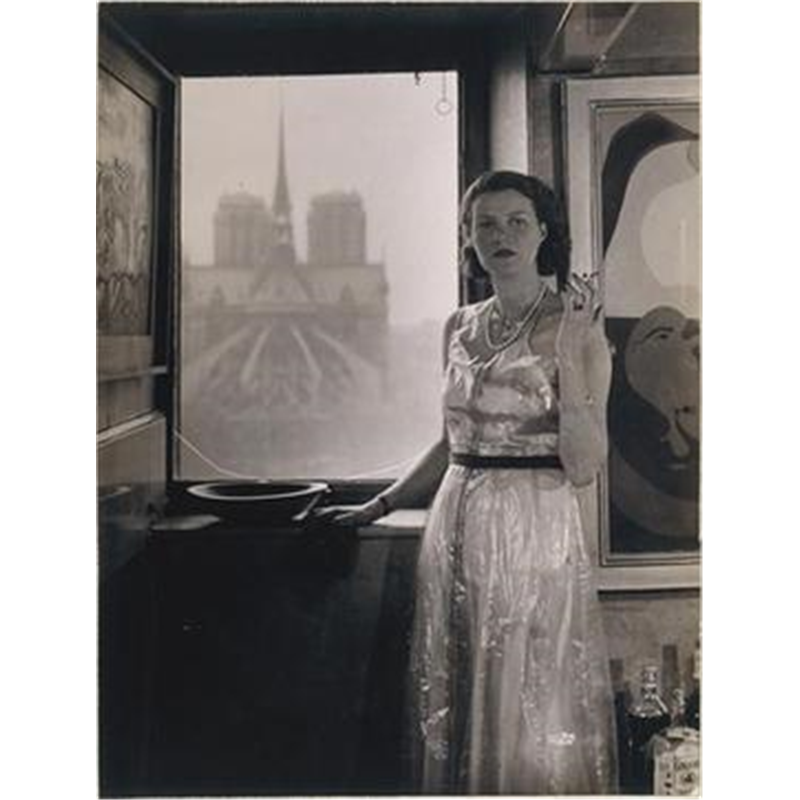 |
2022 lectures began in January on Zoom with Arts Society accredited lecturer Alexandra Epps, who spoke elegantly, and with ample illustration, on the life and achievements of the American art patron and philanthropist Peggy Guggenheim. A lecture which provides insight into Modern Art (in its various schools: Abstract Impressionism, Cubism, Surrealism, Futurism) combined with a legendary personal story is irresistible, as well as immensely instructive, and so it proved. Peggy inherited money from her family, whose backgrounds were in mining and banking, and throughout her career used this capital and the proceeds of investments to accumulate a definitive collection of 20th century painting and sculpture, at a time when much of this art was dismissed as degenerate or simply rubbish, taking advantage of prices much lower than the same works would fetch today. Her initial enthusiasm turned to passion, and she finally defined herself as an art addict, and was also unapologetically attracted to male artists at all stages of her life. After attempts to find exhibitions and galleries for the collection in Paris, London and New York, a museum was finally established in Venice. We hope to resume live lectures in Chequer Mead in February. |
|
| Tuesday, 30 November 2021 |
| Pretty Nell Glyn and her rivals: A Christmas Entertainment |
| Nicholas Reed |
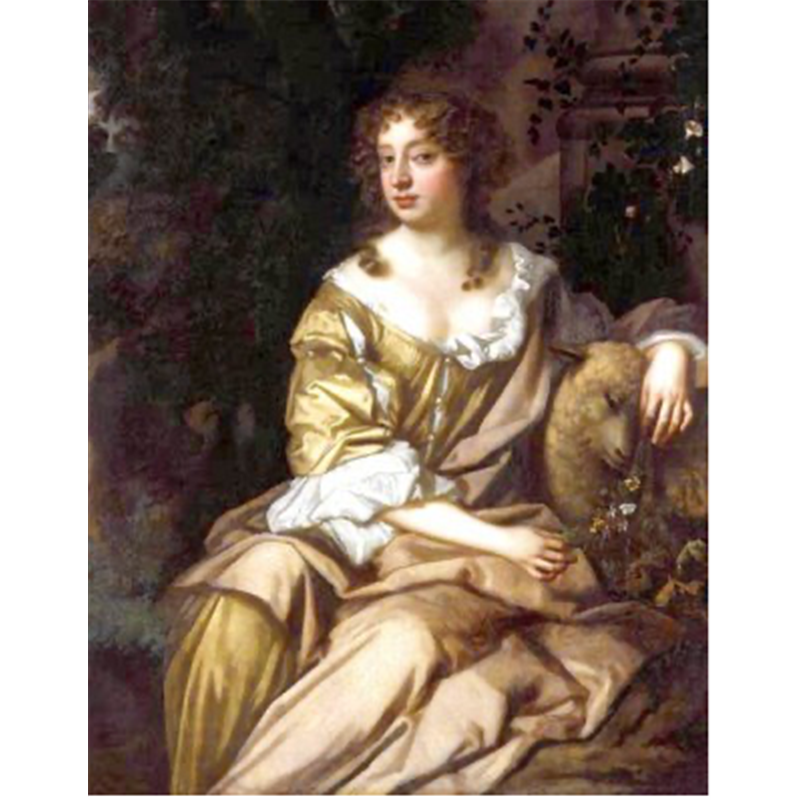 |
The Christmas lecture was given by Nicholas Reed, a well known art historian, archaeologist and accredited Arts Society lecturer. The topic, suitably light for the Season, was “Pretty Nell Gwyn and her Rivals” and the talk entertained us with accounts not only of the life story of this famous 17th century socialite, as far as it can be traced from the historical record, but also of the cavorting and debauchery at the Court of Charles II, in reaction to the Puritan repression that had preceded it under Oliver Cromwell. Painstaking research by Nicholas Reed over many years allowed him to share with us many amusing and sometimes vulgar anecdotes about the relationship between Nell and Charles and also between Nell and her rival mistresses, of whom Charles seems to have had many, too numerous to list here, but each neatly mentioned in cameo during the lecture. It seems Nell rose from a humble origin in Hereford to become a notable actress in London and hence securing passage into the King’s bed. Sadly, she seems to have lost the wealth she accumulated from the King’s largess by excessive gambling and to have died from syphilis. A sad end or well deserved? Oddly, unlike her rivals she was not ennobled, but her son by Charles was, after a fashion. For a selections of the illustrations presented during the lecture, please click HERE |
|
| Tuesday, 09 November 2021 |
| Now you see it, Now you don’t |
| Bertie Pearce |
 |
Our November lecture was given by the well-known Arts Society speaker and performer Bertie Pearce, who is unique in being qualified, experienced and acclaimed both as an art historian and a practicing magician. Inviting Bertie to speak means you have no idea what to expect. His title was “Now you see it, now you don’t”, but the real subject of the talk was the art form known as “Trompe L’Oeil”, which roughly means “to deceive the eye”. Starting with examples from classical times and the Renaissance, Bertie catalogued numerous artists who have made use of this style for all kinds of purposes: philosophical, political, sociological, architectural and commercial, not excluding our own Banksy. Far too many to itemise here, but see the attached photos HERE for some idea. Bertie has a great way with audiences, larding his talk with humour at every turn and welcoming interaction with the listeners even to the extent of encouraging hecklers and responding humorously to interruptions from renegade mobile phones. Overall great entertainment AND a learning experience. What else is The Arts Society for? There were no conjuring tricks, though Bertie alluded to the role of visual deception in all its forms, even including road markings and cricket pitches. For more information, click HERE |
|
| Tuesday, 12 October 2021 |
| Royal Jewels and the American Heiress - Antique Treasurers of the New World |
| Andrew Prince |
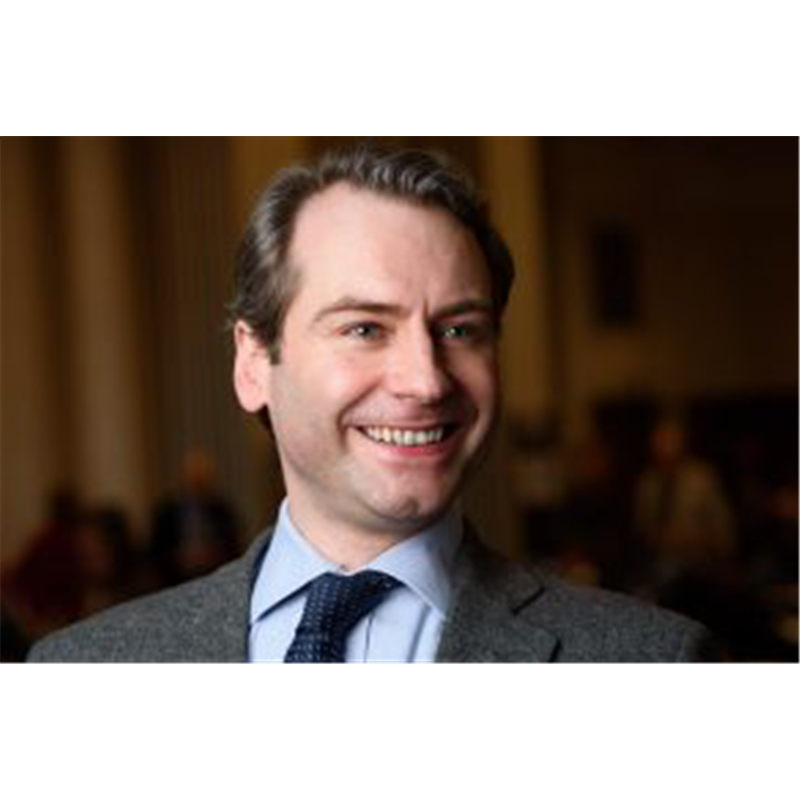 |
Our live lecture programme resumed in October 2021. First up was TAS accredited lecturer Andrew Prince on the subject of "Royal Jewels and the American Heiress - Antique Treasurers of the New World”. Andrew explained that he has had a passion for jewellery since he was a small child fascinated by the contents of his mother’s jewellery box. After seeing an exhibition of Renaissance jewels at the V&A at the age of nine, Andrew decided that creating jewellery was what he wanted to devote his life to. Work for the V&A, and for stars such as Michael Jackson and Shirley Bassey, led to a commission to supply a large collection of jewellery for the third series of Downton Abbey. He produced jewels for the main characters, which inspired him to create a series of talks based around the Downton Abbey period and the changing styles of the time portrayed. Since then he has become absorbed in the origin of particular stones and how their ownership and settings have changed over time. Jewellery and Fashion are often seen as two entirely separate and distinct fields of design, but this, he explained, is very far from the case. Andrew guided us through periods from the 18th Century tracing valuable stones and polished jewels particularly from Asia and how they became owned by monarchs and other heads of state in Europe, Russia and in many instances by wealthy Americans when the funds of previous owners ran low or the owners passed away (or in some cases executed!) and the jewels sold. Some even being lost for long periods then turning up again in a different setting, in a different country. The great fashion houses collaborated with the finest of jewellers to produce works of art of outstanding quality and glittering opulence. On several occasions the same jewels were returned by their new owners with instructions to produce alternative shapes and settings. Andrew discussed many of these clients and patrons and how the same jewels featured in paintings and in more recent years photographs being worn with the sumptuous gowns. |
|
| Tuesday, 14 September 2021 |
| "Fashion, Fury and Feminism" |
| Tessa Boase |
 |
The Arts Society commenced its 2021/2022 season with the AGM, followed by a Zoom lecture by Tessa Boase on "Fashion, Fury and Feminism". The talk, unusual in topic and delivered very professionally as a series of video clips, told the story of the RSPB (Royal Society for the Protection of Birds) and how it emerged in its modern form in 1904 under the leadership of a number of formidable late Victorian women, notably Etta Lemon, Emily Williamson and Eliza Phillips, assisted by many others including members of the aristocracy. These pioneers were tireless campaigners against the plumage trade, at the time a huge business supplying the demands of women from all classes to wear feathered hats, the more elaborate the better, but fatal for millions of birds all over the world. We learned that even such a philanthropist cause was closely caught up in the politics of the time, especially the struggle for (and against) women's right to vote, bringing the early conservationists into conflict with the suffragettes and suffragists, whose insistence on smart appearance for their public demonstrations included the wearing of feathered hats. You can read more by clicking HERE |
|
| Tuesday, 08 June 2021 |
| The Bayeux Tapestry |
| Imogen Corrigan |
 |
Today, we all enjoyed a fascinating insight into this famous historical artefact. After nearly 20 years in the British army, Imogen Corrigan went to the University of Kent to study Anglo-Saxon & Medieval History and Art, graduating with 1st class honours, followed by an MPhil from the University of Birmingham. She works as a freelance lecturer across Britain and Europe as well as lecturing on small cruise ships and running study tours and courses on land. A Freeman of the City of London, being a Member of the Company of Communicators. There is far more to be discovered about the Bayeux Tapestry than could ever be covered in one lecture. Who made it, where and why are the most frequently asked questions – although they might also be seen as less important beside the information the tapestry itself offers us. It is not just a narrative of the most famous battle in English history, but also of the build-up to it. It is a moral story showing that good cannot come to those who break their word. It is a story of kings, chivalry and ambition. Intriguingly, many crucial events are omitted and we can only speculate as to why. The tapestry itself is woven from only 10 different colours on linen, but remains as vibrant today as it must have been 900 years ago. The lecture examined many of the scenes in detail and explored what might be learned from this depiction of a turning point in our history. You can read more HERE |
|
| Tuesday, 11 May 2021 |
| Portraits in Stone: The Great Cathedrals of Medieval England |
| Mark Cottle |
 |
Mark Cottle was born on the Isles of Scilly and educated at Truro School, Cornwall, and Birmingham University. His career has been spent in education and training at home and abroad. He has lectured at Exeter College on Medieval and Tudor history, St Mark's & St John's University College, Plymouth, and at Bath University on Anglo Saxon and medieval England and currently runs two small companies providing training and study breaks. On 11 May, we enjoyed a fascinating lecture from Mark. Over a time span of five hundred years the great medieval cathedrals of England were built. In terms of resources called upon, space covered, design and craftsmanship employed, this period marks the greatest single architectural achievement in English history. From Durham to Gloucester, the lecture followed the evolution of cathedral building with particular reference to structural and aesthetic details together with some of the fascinating figures and events behind them – portraits in stone as rich as a great East Window. For more information, please click HERE For a suggested reading list, please click HERE |
|
| Tuesday, 13 April 2021 |
| A Brief History of Wine |
| David Wright |
 |
David Wright has been a wine retailer, importer and distributor for 30 years. In that time, he has publicly presented tastings and talks on wine to trade and private audiences. These have taken the form of wine ‘tastings’ or charity events where a particular subject is presented and wines tasted. A Brief History of Wine, is full of rich evidence on the subject of wine, going back 7,000 years, in the form of paintings, decorated drinking vessels, buildings and literature that contribute to the story. According to David, wine was noted to be drunk by the Persian kings in the 9th century in a book named “ Book of Kings”. Wine was then kept in amphoras and it was the beverage of the Courts. It was also thought to have started in the Caucasian mountains that surrounded Georgia and Turkey. In Georgia, they were kept in “ kwevri” which are terracotta pots, still used to this present day. The first cultivated vines were discovered through DNA samples that were more than 5,000 BC. Wine was also discovered in Egypt where amphoras of wine were found in the tomb of King Tutankhamen. It then spread to Greece, to the island of Kios and eventually to the Romans. At Pompeii, remnants of shops where wine was sold and also, mosaics of vines and amphoras of wine are discovered.
David, then went through more present times to Burgundy, France where the first, present day vine yards were started by the Benedictine monks. Burgundy is considered by wine connoisseurs to be the best wine in the world today. David ended his lecture by reminding us that wine is to be enjoyed in moderation and not in excess. The reason that wine is so expensive in the UK is partly to discourage people from drinking excessively. You can read more about David Wright HERE |
|
| Tuesday, 09 March 2021 |
| The Dancing Faun: A Personal Story of a Masterpiece |
| Bertie Pearce |
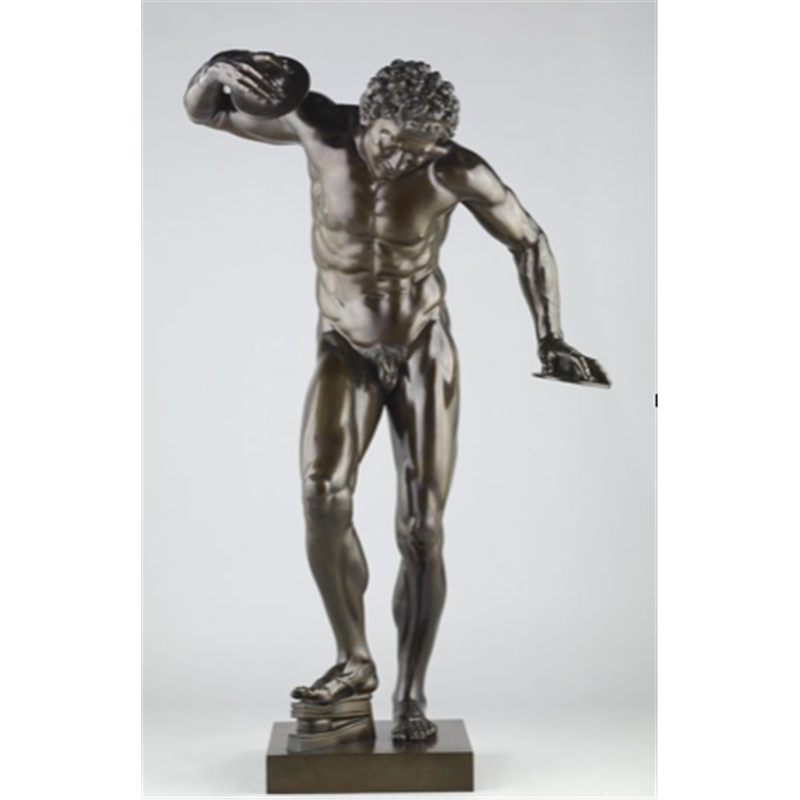 |
In this lecture Bertie recounted the extraordinary tale of how a small bronze statue, which had sat in his Grandfather’s garden for 40 years, was discovered as a master piece and ended up in the Getty Museum, California. This was a fascinating lecture. Bertie told the story of a ‘garden statue’ bought by his grandparents which had an amazing ending. We learnt about his family history, their family home, the sequence of events that led to the discovery, how statues are constructed by the sculptor, the sculptor involved and his personal history and influences. You can read more by clicking HERE |
|
| Tuesday, 09 February 2021 |
| Cleopatra: The Most Womanly of Women & the Most
Queenly of Queens |
| Lucy Hughes Hallett |
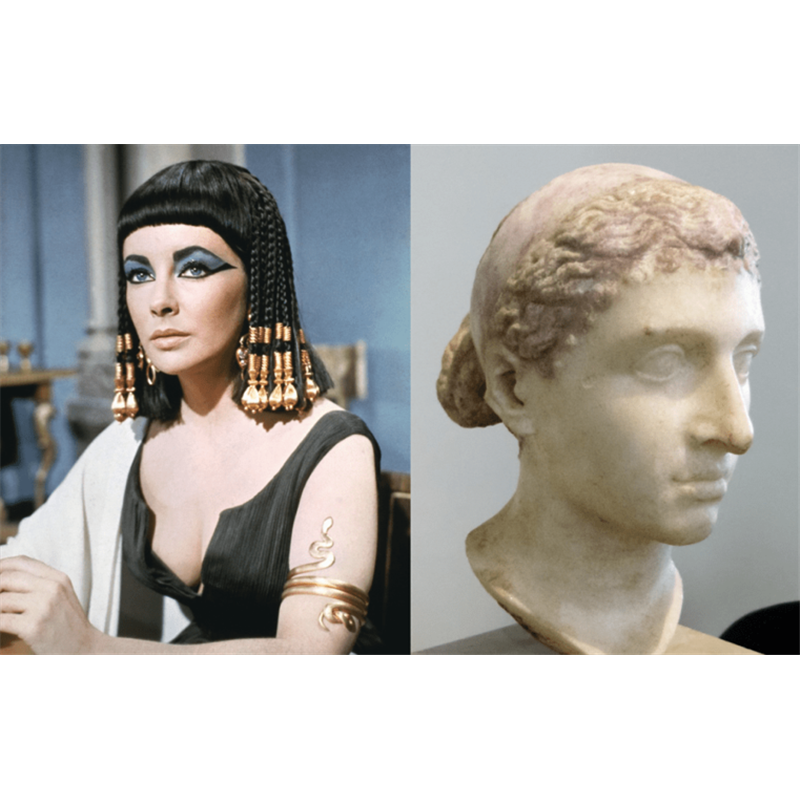 |
Lucy Hughes-Hallett is a cultural historian and biographer. Her book on Gabriele d’Annunzio, The Pike, was described in The Sunday Times as ‘the biography of the decade’. It won all three of the UK’s most prestigious prizes for non-fiction - the Samuel Johnson Prize, the Duff Cooper Prize and the Costa Biography Award. Her other non-fiction books include Cleopatra and Heroes. Cleopatra, the woman for whose love’s sake Antony is imagined to have given up the chance to rule the Roman world, has been inspiring painters, poets and (more recently) film-makers for over two millennia. Their gorgeously voluptuous depictions of her offer insights into changing concepts of beauty, and into the racial and sexual assumptions underlying them. Through images ranging from Roman portrait busts, through medieval illuminations, the glorious works of Renaissance masters like Michelangelo, the splendour of Tiepolo and the exoticism of Gustave Moreau to 20th century film stars (Theda Bara, Claudette Colbert, Vivien Leigh, Elizabeth Taylor and the Carry On team’s Amanda Barry), Lucy showed how Cleopatra became a screen onto which artists have projected their wildly differing fantasies about exotic danger and erotic bliss. |
|
| Tuesday, 19 January 2021 |
| Cloisters - Remarkable cathedral survivors |
| Janet Gough |
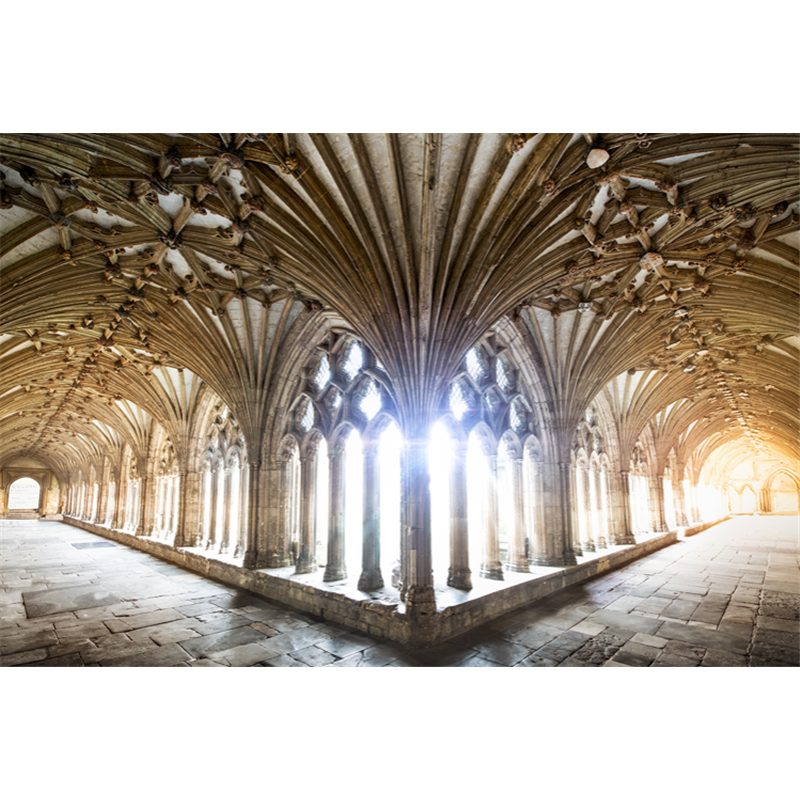 |
For eight years the Church of England’s Director of Church Buildings and Secretary of the Church Buildings Council and Cathedrals Fabric Commission, Janet has written two illustrated paperbacks to encourage greater enjoyment of these amazing buildings and produced and presented on a TV series on cathedrals for PBS. Medieval cloisters, originally a monastic built space linking other buildings, have in spite of Henry VIII's thorough Dissolution of the Monasteries in the 1530s, probably survived better in England than anywhere else. This is in large part because early on English cathedral communities both recognised their great usefulness and experimented with cutting edge architecture in building cloisters and in so doing created some extraordinarily beautiful spaces. The talk followed the development of the 15 or so cathedral cloisters in England with spectacular photographs, and will hopefully encourage visitors to cathedrals to look beyond the cathedral church buildings and more closely at the cloisters attached to them. |
|